
+86-18668977520
+86-18668977520

Views: 0 Author: Site Editor Publish Time: 2026-07-02 Origin: Site


Sourcing chemical reagents for synthesis carries inherent operational and financial risks. A single substandard batch can compromise downstream yields, trigger safety hazards, or ruin entire production runs. When dealing with thermally sensitive compounds, relying solely on vendor marketing claims or generic specification sheets exposes procurement and QA teams to unacceptable liabilities. aminoguanidine bicarbonate requires specific handling and purity verification. To secure a reliable supply chain, buyers must rigorously scrutinize the Certificate of Analysis (COA). This guide breaks down the exact technical specifications, impurity thresholds, and testing methodologies to verify on a COA before approving a purchase order.
Purity Validation: High-purity aminoguanidine bicarbonate should be verified via established liquid chromatography (HPLC) methods, not just basic titration.
Thermal Sensitivity: The COA and accompanying documentation must account for the chemical's instability above 50°C to ensure safe transit and storage.
Impurity Profiling: Strict limits on heavy metals, ash, and moisture content are non-negotiable for synthesis-grade applications.
Vendor Accountability: A valid COA must offer full traceability, including clear batch numbers, manufacturing dates, and transparent testing methodologies.
The COA serves as the primary legal and technical document bridging the gap between supplier claims and actual chemical reality. It provides the empirical evidence necessary to confirm that the material meets the strict specifications required for your specific application. Procurement teams often confuse a Technical Data Sheet (TDS) with a COA. A TDS outlines the typical properties of a chemical based on historical averages. A batch-specific COA provides the exact test results for the specific lot you are purchasing. Buyers must demand batch-specific data to ensure the material received matches the required quality standards.
The required stringency of the COA changes depending on the end-use. Agricultural synthesis may tolerate slightly different impurity profiles compared to pharmaceutical intermediates or general research and development. In pharmaceutical applications, trace contaminants can severely impact final product viability, alter reaction kinetics, or introduce toxic byproducts that fail regulatory audits. A robust COA acts as the first line of defense against these downstream failures.
When reviewing a COA, you are not just checking boxes. You are validating the manufacturer's quality control infrastructure. A supplier that consistently provides detailed, method-backed COAs demonstrates a commitment to process control. Conversely, a supplier offering vague documents with missing test methods or generic ranges is signaling a lack of analytical capability. This distinction separates reliable partners from high-risk vendors.
To prevent compounding errors or mislabeling, the COA must explicitly list standard identification metrics. Verifying these identifiers is the first step in confirming you are receiving the correct compound. Chemical nomenclature can be complex, and synonyms often create confusion on the receiving dock. Standardized identifiers eliminate ambiguity.
Identifier Type | Required Specification | Purpose on COA |
|---|---|---|
CAS Number | 2582-30-1 | Primary global registry identifier for cross-referencing SDS and shipping manifests. |
Chemical Formula | C2H8N4O3 | Confirms the exact atomic composition for stoichiometric calculations. |
Molecular Weight | ~136.11 g/mol | Essential for accurate mass-to-mole conversions during synthesis planning. |
IUPAC Name | Aminoguanidinium hydrogen carbonate | Provides the formal structural name, preventing confusion with similar guanidine derivatives. |
Receiving personnel must cross-reference these exact identifiers against the physical drum labels and the original purchase order. A mismatch in the CAS number, even by a single digit, requires immediate quarantine of the shipment until the discrepancy is resolved with the manufacturer.
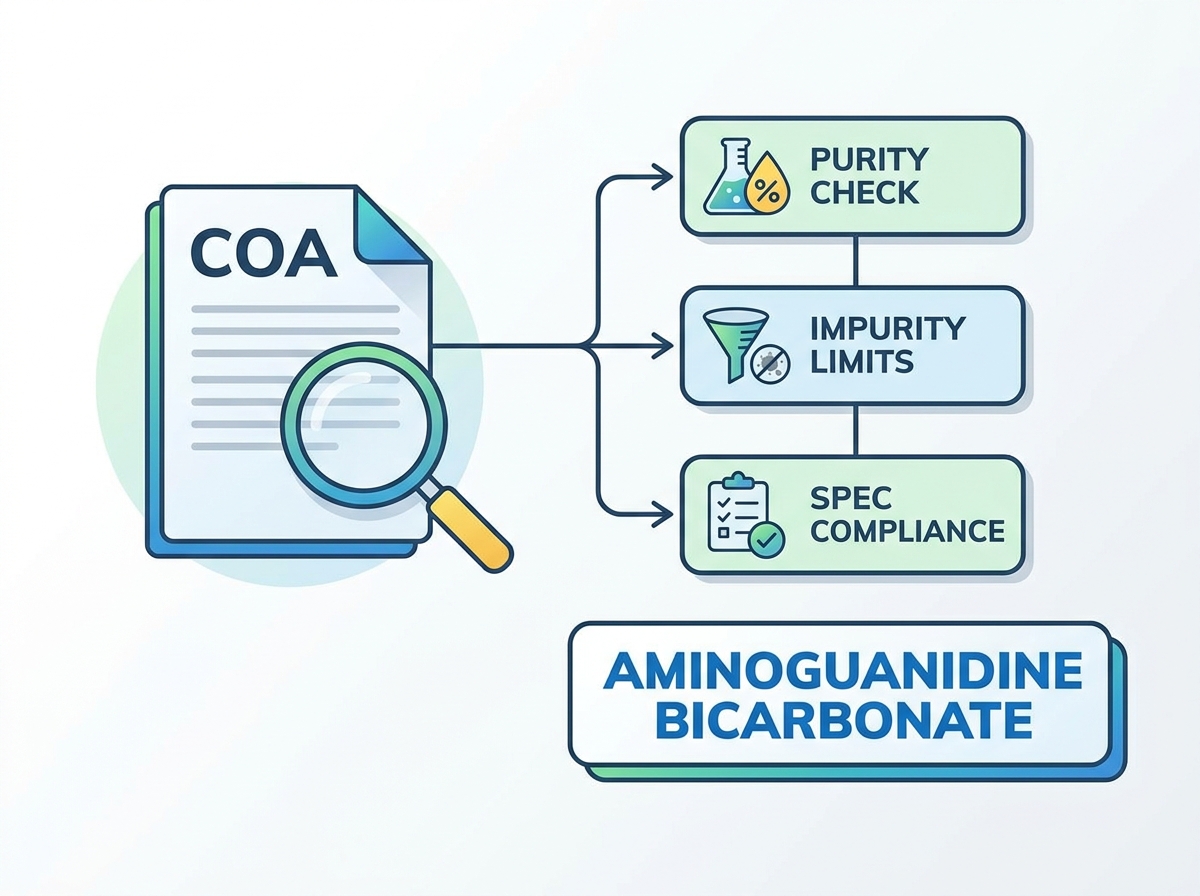
The assay percentage indicates the concentration of the active compound. Acceptable assay ranges typically fall between ≥98% and ≥99.5%, depending on the required grade. When evaluating claims of high-purity aminoguanidine bicarbonate, check the specific testing method cited on the COA to ensure the results are accurate and reproducible.
Basic titration methods can sometimes inflate purity numbers by reacting with structurally similar impurities. Therefore, high-purity grades must rely on more advanced analytical techniques. If the COA only lists "Titration" without specifying the titrant or the standard method used, the purity claim remains questionable for sensitive synthesis applications.
Loss on Drying (LOD) measures the amount of volatile matter, primarily moisture, driven off under specified conditions. Acceptable LOD thresholds must be strictly maintained, typically below 0.5% for high-grade materials. Excess moisture accelerates degradation and leads to inaccurate mass measurements during synthesis, directly impacting stoichiometric calculations.
Because this compound can absorb moisture from the environment if improperly sealed, the LOD metric also serves as an indicator of packaging integrity. A high LOD on a fresh batch suggests poor drying processes at the manufacturing facility, while a high LOD on an older batch suggests compromised packaging during storage.
This compound exhibits inherent thermal instability, gradually decomposing when temperatures exceed 50°C. The COA or accompanying MSDS should reflect stringent storage temperature requirements. Proper thermal management guarantees the assay remains accurate from the testing date through transit and delivery.
Verify the recommended storage temperature on the COA matches your facility's climate-controlled warehousing capabilities.
Check the testing date. If the material has been stored in uncontrolled conditions for months, the original assay value is likely no longer valid.
Look for specific handling notes regarding temperature excursions during shipping, especially for summer transit routes.
Liquid chromatography (HPLC) is necessary for accurately detecting organic impurities and unreacted precursors like hydrazine hydrate or cyanamide. Buyers should look for specific chromatographic parameters, such as column type, mobile phase, and detection wavelength, or references to standardized testing methodologies on the COA.
Without HPLC data, you are flying blind regarding the actual organic impurity profile. Unreacted hydrazine hydrate, for example, is highly toxic and reactive. Its presence, even in trace amounts, can derail a sensitive catalytic reaction or pose severe safety risks to operators handling the raw powder.
Standard acceptable limits for heavy metals are often expressed in parts per million (ppm), typically requiring levels <10 ppm. Heavy metal contamination can poison catalysts in downstream synthesis processes, leading to failed reactions and significant financial losses.
The COA should ideally break down specific problematic metals rather than just providing a generic "Heavy Metals" pass/fail result. Lead (Pb), Arsenic (As), and Iron (Fe) are common culprits that require strict monitoring, especially if the final product is destined for agricultural or pharmaceutical use.
Ash content indicates the presence of inorganic impurities remaining after combustion. For synthesis-grade procurement, standard acceptable thresholds are typically ≤0.1%. Higher levels suggest poor manufacturing controls, inadequate filtration, or contamination from reactor vessels during processing.
A high ash content often correlates with high iron or silica levels. If your process involves sensitive filtration steps later in the production line, these inorganic insolubles will prematurely blind your filters, increasing maintenance downtime and consumable costs.
The baseline standard appearance is a white or almost white crystalline powder. A color shift, such as turning pink or red, indicates severe thermal degradation. This discoloration typically occurs when heated near 100°C, often observed during oil bath testing, and should result in immediate batch rejection.
Visual inspection remains one of the fastest and most reliable initial quality checks. Receiving teams should be trained to open a sample container and verify the color against a known standard. Any deviation from pure white warrants a hold on the shipment pending full laboratory analysis.
The COA should state solubility characteristics, noting it is soluble in water but practically insoluble in ether and alcohol. Incomplete solubility or the presence of residue indicates insoluble impurities or degradation products that could interfere with subsequent chemical reactions.
Performing a quick solubility test in the lab can confirm the COA's claims. If the powder leaves a cloudy suspension or particulate matter in water, the batch contains unacceptable levels of inorganic contaminants or polymerized degradation products, regardless of what the paperwork claims.
While the COA proves quality, it must align with the MSDS regarding specific handling precautions. This includes avoiding the inhalation of dust, fumes, gas, mist, vapors, or spray. Strict hygiene measures, including immediate handling protocols for contaminated work clothing, are essential. Verify regulatory declarations, such as the mandatory "Not intended for animal or human use" restriction for Certified® Reagent grades.
Operators must wear appropriate personal protective equipment (PPE), including NIOSH-approved dust masks and nitrile gloves. The COA's purity data directly informs the risk assessment; a batch with higher levels of unreacted precursors requires more stringent handling protocols than a highly purified reagent grade.
Matching the COA batch number to the physical container labels is critical for traceability. Discrepancies here invalidate the quality assurance process. Furthermore, understanding the manufacturing date versus the retest or expiry date helps determine the remaining shelf life and viability of the chemical.
A reliable vendor maintains a clear, unbroken chain of custody. The batch number on the COA must perfectly match the lot number stamped on the drums. If a supplier sends a generic COA without a specific batch number, they are providing a specification sheet, not a true Certificate of Analysis. This practice is unacceptable for critical raw materials.
Check if the COA lists the specific analytical methods used, such as USP, EP, or internal validated HPLC methods. Exercise skepticism toward COAs that list results without stating the testing methodology, as these figures cannot be independently verified or trusted for critical applications.
When a vendor cites an "Internal Method," request a summary of that method. Reputable manufacturers will gladly share their analytical parameters (e.g., HPLC column specs, flow rates) to prove their data is robust. Vendors who refuse to share testing methodologies are often hiding inadequate quality control practices.
Accepting a manufacturer's in-house COA relies on vendor trust, whereas requiring third-party analytical testing provides independent verification. For high-stakes procurement, third-party validation mitigates the risk of biased reporting and ensures the material meets all stated specifications.
Implementing a routine third-party testing program for incoming raw materials keeps suppliers honest. You do not need to test every single drum, but pulling random samples from different lots for independent HPLC analysis establishes a baseline of vendor reliability and protects your production line from unexpected contamination events.
A significant risk is that the COA was accurate at the factory, but the chemical degraded during shipping due to temperature fluctuations. To mitigate this, mandate temperature-controlled logistics and require arrival testing to confirm the material's integrity upon receipt.
Because this compound decomposes above 50°C, shipping it in standard dry vans during the summer months is a recipe for disaster. The interior of a shipping container can easily exceed 60°C. Procurement contracts must specify temperature-controlled freight, and receiving docks should utilize temperature loggers to verify the transit conditions remained within safe limits.
Purchasing an industrial grade when a Certified® Reagent grade is required for analytical or R&D purposes can ruin experiments. Cross-reference the COA's stated grade with the project's strict regulatory or synthesis requirements to ensure compatibility.
Industrial grades often contain higher levels of ash and heavy metals, which are perfectly acceptable for bulk agricultural synthesis but disastrous for pharmaceutical intermediates. Always ensure the purchasing department understands the technical difference between these grades and does not simply buy the cheapest option available on the market.
Aminoguanidine bicarbonate procurement should be approved only after reviewing a complete, batch-specific Certificate of Analysis. The COA must confirm chemical identity, assay, moisture, ash, heavy metals, and relevant organic impurities using clearly stated and reproducible analytical methods.
For high-purity applications, chromatographic data provides stronger evidence than a general titration result alone. Batch numbers, manufacturing and testing dates, grade information, and retest or expiry dates should also match the physical labels and purchasing documents to maintain full traceability.
Because the material is thermally sensitive, quality verification cannot end at the supplier’s laboratory. Storage requirements, shipping temperatures, packaging integrity, and arrival condition must also be controlled. Combining detailed COA review with incoming inspection and periodic independent testing reduces procurement risk and protects downstream synthesis quality.
A: Standard purity ranges typically fall between 98% and >99.5%. Industrial grades may sit at the lower end, while reagent grades require higher purity for analytical applications.
A: The CAS No. is 2582-30-1. This number is essential for cross-referencing shipping logs, SDS, and COA files to ensure accurate material identification.
A: The compound is unstable when heated, gradually decomposing when temperatures exceed 50°C.
A: Turning red indicates severe thermal degradation. This typically occurs when the compound is exposed to temperatures near 100°C, such as in an oil bath or due to poor storage conditions.
A: Liquid chromatography (HPLC) is the most reliable method for detecting organic impurities and verifying high purity levels.
A: LOD measures moisture content. High moisture affects the active chemical weight, alters stoichiometric calculations, and can accelerate compound degradation.
A: Certified® Reagent grade has stricter impurity thresholds and includes regulatory statements like "not for animal or human use." It is intended for analytical and R&D synthesis, whereas industrial grade is used for bulk manufacturing.


