
+86-18668977520
+86-18668977520

Views: 0 Author: Site Editor Publish Time: 2026-01-23 Origin: Site


Have you ever wondered how chemical reactions happen step by step? In organic chemistry, intermediates play a crucial role in this process.
This article delves into the different types of intermediates, such as carbocations, carbanions, radicals, and carbenes. You will learn how these short-lived species influence reaction pathways and their importance in predicting reaction outcomes.
A reaction intermediate is a transient chemical species that forms during the course of a chemical reaction but is not present at the beginning or end of the process. These intermediates are crucial because they allow the reaction to proceed from reactants to products. Often, intermediates exist only briefly before they are converted into more stable species. Their short lifespan makes them difficult to isolate and study directly, but advanced techniques such as spectroscopy and kinetic studies have provided insight into their structures and behavior.
Intermediates are essential for understanding the step-by-step mechanisms of organic reactions. During a reaction, they act as bridges, facilitating the transformation from reactants to final products. For example, in many organic reactions, intermediates like carbocations or free radicals are created when bonds are broken or formed. These intermediates are highly reactive and quickly transition into more stable species, guiding the reaction along a particular pathway.
The study of intermediates helps chemists predict the outcome of reactions, optimize conditions, and develop new synthetic routes. Without intermediates, it would be impossible to explain the specific steps or provide detailed reaction mechanisms.
Reaction intermediates are defined by their instability, high reactivity, and transient nature. They are often formed through bond-breaking or electron transfer processes. While intermediates are typically not observed in the final reaction products, their presence is inferred from experimental data. Their behavior can be detected through indirect methods, such as observing reaction rates, using isotope labeling, or employing spectroscopic techniques. Despite their fleeting existence, intermediates are crucial in shaping the course of chemical reactions.
Carbocations are positively charged intermediates in which a carbon atom has lost one electron, resulting in a species with a vacant p-orbital. These intermediates are highly reactive and can participate in various organic reactions, including nucleophilic substitution and electrophilic addition. Carbocations play a central role in many reaction mechanisms, particularly in the rearrangement and addition reactions.
The stability of carbocations depends on factors such as hyperconjugation, resonance, and inductive effects. Tertiary carbocations are more stable than secondary or primary carbocations due to the greater number of alkyl groups, which stabilize the positive charge through electron donation. For example, allylic and benzylic carbocations are particularly stable because of resonance stabilization.
Carbanions are negatively charged intermediates where a carbon atom possesses a lone pair of electrons. Unlike carbocations, which are electron-deficient, carbanions are nucleophilic and seek electrophilic centers to donate their electrons. These intermediates are formed when a strong base deprotonates a substrate, leaving behind a negatively charged carbon atom.
The stability of carbanions is influenced by factors such as hybridization, inductive effects, and resonance. For example, carbanions formed adjacent to electronegative atoms like oxygen or fluorine are more stable due to the ability of these atoms to stabilize the negative charge through electron withdrawal. The stability of carbanions follows this general order: methyl > primary > secondary > tertiary.
Radicals are intermediates with an unpaired electron, making them highly reactive and prone to reacting with other species to pair their electrons. These intermediates are commonly involved in chain reactions such as polymerization, combustion, and halogenation. Radicals are formed when a covalent bond undergoes homolytic fission, where each atom in the bond retains one of the shared electrons.
Radicals typically adopt a planar structure with sp² hybridization. Their stability is influenced by resonance, hyperconjugation, and the presence of stabilizing groups. For example, tertiary radicals are more stable than secondary or primary radicals due to the ability of alkyl groups to stabilize the radical through electron donation. Allylic and benzyl radicals are particularly stable due to resonance stabilization.
Carbenes are neutral intermediates with a divalent carbon atom that possesses two non-bonded electrons. These intermediates can exist in two electronic states: singlet and triplet. In the singlet state, the two electrons are paired in one orbital, while in the triplet state, the electrons occupy separate orbitals. Carbenes are highly reactive and can act as either electrophiles or nucleophiles, depending on their electronic structure.
Carbenes are involved in various reactions, including cyclopropanation and insertion reactions. Due to their high reactivity, carbenes are difficult to isolate and are often generated in situ during reactions. Methylene (CH₂) is the simplest carbene, and it plays a key role in several organic reactions, such as the Simmons-Smith reaction.
Intermediate Type | Charge | Example Reactions | Characteristics |
Carbocations | Positive | Nucleophilic substitution, rearrangements | Highly reactive, electron-deficient carbon atom |
Carbanions | Negative | Nucleophilic addition, substitution | Electron-rich, can donate electrons to other molecules |
Radicals | Neutral | Polymerization, combustion | Unpaired electrons, highly reactive |
Carbenes | Neutral | Cyclopropanation, insertion | Neutral species with two non-bonding electrons |
The reactivity and stability of reaction intermediates vary significantly. Carbocations, carbanions, radicals, and carbenes each exhibit unique reactivity patterns based on their electronic configurations. Carbocations are electrophilic and seek to accept electrons, while carbanions are nucleophilic and seek to donate electrons. Radicals, with an unpaired electron, are highly reactive and engage in various chain reactions. Carbenes, being neutral with two non-bonding electrons, can act as either nucleophiles or electrophiles.
The stability of intermediates also follows distinct trends. Carbocations are most stable when they are tertiary, followed by secondary and primary, while carbanions are most stable when they are methyl or primary. Radicals are most stable when they are tertiary, followed by secondary and primary.
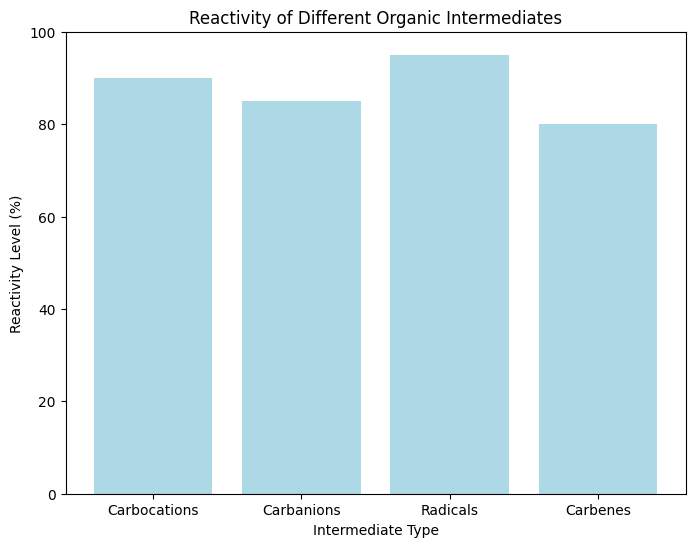
Substituents can significantly affect the stability of intermediates. In carbocations, alkyl groups stabilize the positive charge through hyperconjugation and inductive effects, leading to greater stability for tertiary carbocations. Similarly, the presence of electron-withdrawing groups can destabilize carbanions, while electron-donating groups can stabilize them.
For radicals, the presence of substituents that stabilize the unpaired electron, such as alkyl groups or resonance structures, increases their stability. In carbenes, the stability is influenced by the nature of the substituents attached to the carbon atom, as well as the electronic effects they induce.
Intermediate Type | Stability Order | Stability Factors |
Carbocations | Tertiary > Secondary > Primary | Hyperconjugation, resonance, inductive effects |
Carbanions | Methyl > Primary > Secondary > Tertiary | Electronegative atoms, hybridization, resonance |
Radicals | Tertiary > Secondary > Primary | Stabilization by alkyl groups, resonance effects |
Carbenes | Varies (singlet vs triplet) | Substituents and electronic effects on stability |
Intermediates provide valuable insight into the mechanisms of chemical reactions. By studying the formation, stability, and reactivity of intermediates, chemists can deduce the sequence of steps in a reaction. Intermediates serve as key markers for understanding how reactants are converted into products and allow chemists to optimize conditions for the desired outcome.
Several techniques are used to detect and identify intermediates. Spectroscopic methods, such as nuclear magnetic resonance (NMR) and infrared (IR) spectroscopy, can provide information about the structure of intermediates. Kinetic studies can track the rates of reactions and provide insight into the role of intermediates. Trapping experiments, where intermediates are captured and converted into stable products, are also valuable for studying transient species.
Intermediates play a crucial role in organic synthesis by facilitating the formation of complex molecules. They guide the transformation of simple reactants into highly specialized products. Understanding how intermediates behave allows chemists to design more efficient synthetic routes, minimizing side reactions and improving yields.
Reaction Type | Intermediate Involved | Example | Key Role of Intermediate |
Nucleophilic Substitution | Carbocations | SN1 reactions | Carbocation forms before nucleophilic attack |
Addition Reactions | Carbanions | Aldol condensation | Carbanion attacks electrophile |
Polymerization | Radicals | Radical chain polymerization | Radicals initiate polymer chain growth |
Cyclopropanation | Carbenes | Simmons-Smith reaction | Carbene forms cyclopropane ring |
In pharmaceutical chemistry, intermediates are essential for the synthesis of active pharmaceutical ingredients (APIs). By understanding the intermediates formed during the synthesis of drugs, chemists can optimize the production process and improve drug efficacy. Intermediates also help in designing drugs with fewer side effects by providing insight into the potential metabolic pathways and reactions.
Intermediates are widely used in industrial processes, including polymerization, the production of agrochemicals, and the synthesis of materials. In polymerization, for example, free radicals play a key role in initiating the polymerization of monomers, leading to the formation of long polymer chains. Similarly, intermediates are crucial in the production of pesticides and fertilizers, where they help in the formation of active compounds.
Managing intermediates in chemical reactions is important for reducing waste and minimizing environmental impact. By controlling the formation and stability of intermediates, chemists can design reactions that produce fewer byproducts and use less energy. This is especially important in industrial applications, where the scale of production can lead to significant environmental effects.
In summary, reaction intermediates such as carbocations, carbanions, radicals, and carbenes are essential in understanding organic chemistry. They influence reaction mechanisms, stability, and reactivity. By studying intermediates, chemists can optimize reactions and improve synthetic processes. Jinan Xinggao Intermediate Technology Co., Ltd. offers specialized products that help streamline chemical processes, providing valuable solutions for industries like pharmaceuticals and manufacturing.
A: A reaction intermediate is a short-lived species formed during a chemical reaction. It helps facilitate the transformation of reactants into products.
A: The main types of intermediates are carbocations, carbanions, radicals, and carbenes. Each plays a distinct role in reaction mechanisms.
A: Intermediates are crucial for understanding reaction pathways and predicting the products of chemical reactions.
A: Carbocations are positively charged intermediates, while carbanions are negatively charged. Both are highly reactive but behave differently in reactions.
A: Intermediates are stabilized by factors like resonance, hyperconjugation, and inductive effects, which influence their reactivity.
A: Radicals are highly reactive intermediates with unpaired electrons. They are involved in chain reactions, such as polymerization and halogenation.


