
+86-18668977520
+86-18668977520

Views: 0 Author: Site Editor Publish Time: 2026-07-09 Origin: Site


Sourcing specialty chemical precursors requires rigorous procurement documentation to prevent supply chain disruptions, safety incidents, and batch failures. Issuing vague Requests for Quotation (RFQs) for hazardous or sensitive compounds often results in inconsistent purity levels, non-compliant safety documentation, and hidden logistical costs during dangerous goods transport. Procurement teams must structure their RFQs to explicitly define technical specifications, safety mandates, and evaluation criteria specific to this chemical to secure reliable, high-quality suppliers. This guide outlines the exact framework for drafting a comprehensive RFQ for aminoguanidine bicarbonate. You will learn how to lock down chemical parameters, enforce safety compliance, and evaluate supplier capabilities beyond surface-level metrics. By standardizing your procurement approach, you eliminate ambiguity and force suppliers to prove their technical competence before a single purchase order is issued.
Define Strict Purity Baselines: Explicitly state required purity grades (typically >98%) and acceptable impurity profiles based on the end-use application (e.g., synthesis vs. corrosion inhibitors).
Mandate Comprehensive Safety Data: Require up-to-date Safety Data Sheets (SDS) that accurately reflect hazard classifications, including environmental hazards (H411) and reproductive toxicity warnings.
Specify Hazardous Packaging: Detail packaging requirements designed to mitigate moisture ingress and prevent dust/fume exposure during transit and storage.
Establish Clear Evaluation Metrics: Base supplier shortlisting on a combination of verifiable Certificates of Analysis (COA), batch-testing protocols, and total landed cost rather than unit price alone.
Failing to establish exact chemical parameters leads to receiving off-spec materials that ruin downstream manufacturing processes. When you leave room for interpretation in an RFQ, suppliers may quote lower-grade materials that technically meet a broad description but fail in your specific application. You must define the baseline parameters with absolute precision.
Require suppliers to confirm the exact chemical identity: aminoguanidine bicarbonate CAS 2582-30-1. Include standard chemical identifiers in the RFQ header to eliminate ambiguity immediately. Suppliers operating globally might use different trade names or regional synonyms, so locking down the exact chemical registry numbers prevents miscommunication.
Your RFQ should include a mandatory specification table that the supplier must sign off on. This forces them to acknowledge the exact compound you require.
Identifier / Parameter | Required Specification |
|---|---|
CAS Registry Number | 2582-30-1 |
IUPAC Name | Carbonic acid, compound with hydrazinecarboximidamide (1:1) |
Molecular Formula | CH6N4·H2CO3 or C2H8N4O3 |
Molecular Weight | 136.11 g/mol |
PubChem CID | 164944 |
Physical State | White or off-white crystalline powder |
Request documentation verifying the structural integrity and physical state of the compound. If a supplier quotes a liquid dispersion or a heavily discolored powder, you immediately know they are either quoting the wrong material or their manufacturing process lacks the necessary refinement steps.
Define the required purity threshold clearly. A minimum of 98.0% is standard for most industrial synthesis applications, but you may need 99.0% or higher for pharmaceutical intermediates. Do not just ask for "high purity." Specify the exact percentage and the analytical method used to determine it, such as High-Performance Liquid Chromatography (HPLC).
Require suppliers to list maximum allowable limits for specific impurities. Trace contaminants can catalyze unwanted side reactions or degrade the final product. Your RFQ must demand limits on:
Heavy metals (typically capped at <10 ppm).
Moisture content (usually <0.5% determined by Karl Fischer titration).
Unreacted hydrazine residues (critical due to toxicity).
Ash content or residue on ignition.
Insoluble matter in water or specific solvents.
Align the specification request with the intended application. If you use the chemical for synthesis, specify its role as a critical precursor for producing guanidine derivatives. If you use it for industrial formulations, note its function as an active agent in advanced corrosion inhibitors. Providing this context helps competent suppliers flag potential compatibility issues early in the quoting process.
Assessing a supplier's regulatory maturity and commitment to safe handling practices separates legitimate chemical manufacturers from risky brokers. You cannot afford to import or transport hazardous materials without airtight documentation.
Stipulate that a fully compliant, region-specific Safety Data Sheet (SDS) must accompany the quotation. A generic, ten-year-old MSDS downloaded from the internet is unacceptable. The document must reflect current Global Harmonized System (GHS) standards.
Require the SDS to clearly display the "Danger" signal word and relevant hazard classifications. You must verify that the supplier acknowledges the specific risks associated with this compound. Explicit warnings regarding reproductive toxicity and potential damage to the unborn child must be present. Ensure environmental hazards, specifically H411 (Toxic to aquatic life with long-lasting effects), are documented accurately.
The handling precautions section must include specific instructions to avoid breathing dust, fumes, gas, mist, vapors, or spray. Request supplier protocols for updating safety documentation. You need to know how they will notify you if hazard classifications change due to new toxicological data.
Ask for proof of compliance with regional chemical inventories. If you operate in Europe, demand proof of REACH registration or pre-registration. If you are in the United States, verify TSCA active status. Failing to confirm these registrations can result in your shipments being seized at customs, causing massive production delays.
Require documentation on qualifying quantities and regulatory storage thresholds based on local hazardous materials regulations. The supplier should be able to provide the exact UN number and proper shipping name required for transport documents.
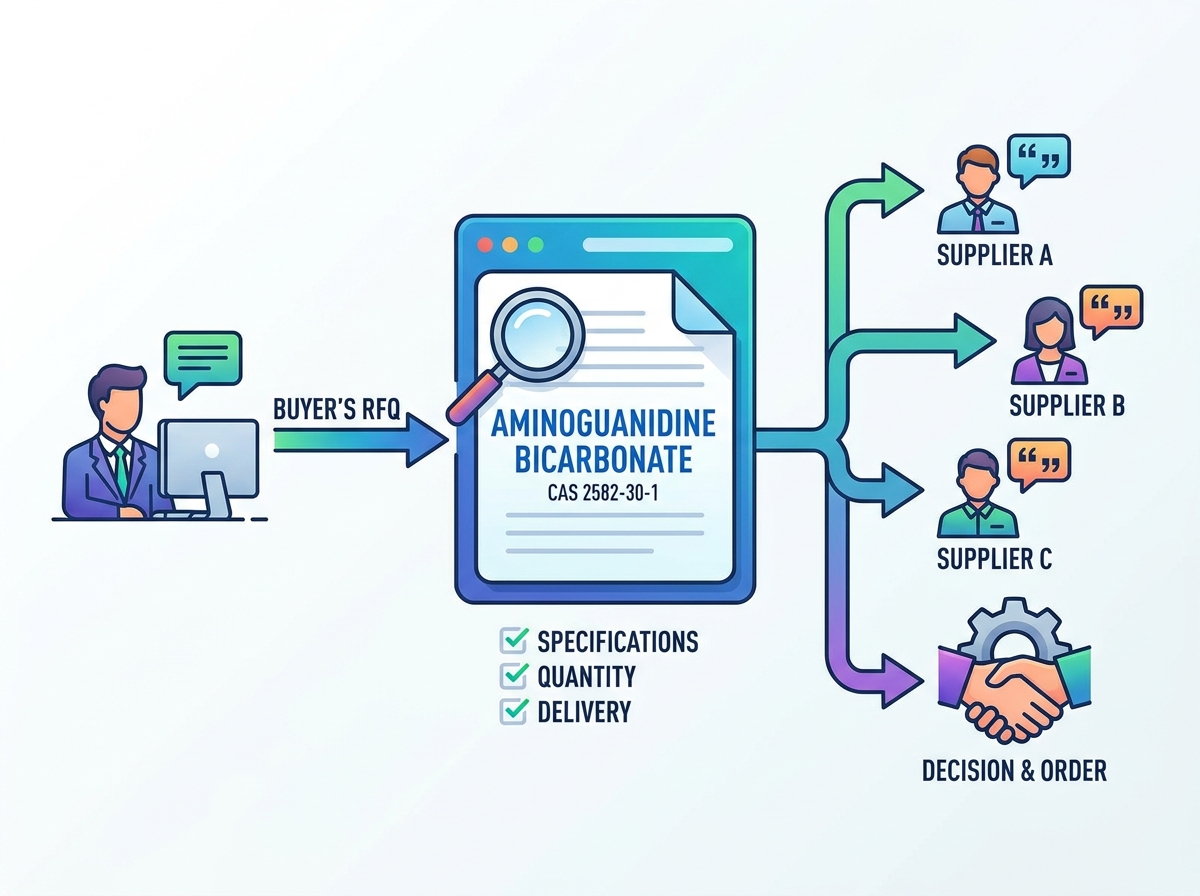
Organizing the RFQ into logical, standardized sections facilitates apples-to-apples supplier comparisons. A scattered RFQ yields scattered responses. Force suppliers to follow your format.
Demand a representative sample Certificate of Analysis (COA) from a recent batch. The COA must match the specifications you outlined in the first section. Outline requirements for third-party laboratory testing or internal batch-testing methodologies. Specify that you expect to see results from HPLC for purity, titration for specific assays, and Karl Fischer for moisture analysis.
Define the process for handling out-of-spec (OOS) deliveries. Your RFQ should state exactly what happens if a batch fails incoming quality control. Will the supplier cover the cost of return freight? Will they expedite a replacement batch? Get these commitments in writing during the quotation phase, not after a failure occurs.
Specify initial trial volumes versus projected annual consumption. Suppliers need to know if they are quoting a one-off 100 kg pilot run or a multi-ton annual contract. Request standard lead times from the date of purchase order to the date of dispatch.
Ask for minimum order quantities (MOQs) and evaluate the supplier's capacity to handle demand surges. If your production ramps up by 30% next quarter, can their current reactor capacity handle the increase? Define the required Incoterms (e.g., DDP, CIF, FOB) to clarify freight, customs clearance, and insurance responsibilities. Be highly specific about delivery locations, especially if your facility has restricted access for heavy freight.
Detail the necessity for UN-approved packaging suitable for dangerous goods. Standard cardboard boxes are entirely insufficient for this material. Specify inner and outer packaging materials required to avoid breathing dust or mist during handling and decanting.
Include requirements for moisture-barrier packaging. The compound degrades when exposed to high humidity. Demand sealed polyethylene-lined fiber drums or specialized moisture-resistant bulk bags. Specify the exact weight per drum (e.g., 25 kg net weight) to ensure compatibility with your facility's lifting equipment and ergonomic policies.
Moving beyond unit price to evaluate the holistic reliability of the supplier prevents you from partnering with operations that cut corners on safety or quality.
Analyze how variations in purity impact downstream yield efficiency. A supplier offering a 98% pure batch might seem attractive on paper, but if that 2% impurity profile contains compounds that poison your catalysts or require extensive post-reaction filtration, the cheaper material actually costs you more in labor and lost yield.
Evaluate the hidden costs of lower-purity materials. Ask your engineering team to quantify the cost of additional purification steps. Use this data to weigh the bids accurately. Sometimes, paying a premium for 99.5% purity eliminates an entire filtration step in your plant, making it the superior choice.
Request details on the supplier's manufacturing process to determine if they are a primary manufacturer or a distributor. Primary manufacturers offer better traceability and direct control over batch consistency. Distributors can offer logistical convenience but often obscure the true origin of the chemical.
Evaluate their supply chain redundancy. Ask where they source their raw materials (like hydrazine derivatives). If their sole raw material supplier goes offline, how long can they continue to supply you? Gauging resilience against market shocks is a mandatory part of modern procurement.
Factor in the specialized freight costs associated with shipping hazardous chemicals. Transporting environmentally hazardous and toxic materials requires certified carriers, specialized placarding, and often higher insurance premiums. Assess the supplier's track record and expertise in navigating international customs, dangerous goods declarations, and port regulations.
A supplier who routinely exports hazardous chemicals will have established relationships with freight forwarders and customs brokers. A supplier who struggles to produce a compliant dangerous goods declaration will cause your shipments to sit in port, racking up demurrage charges.
Identifying potential points of failure post-contract award helps secure the supply chain before the first delivery arrives.
Require suppliers to provide validated shelf-life data under specific storage conditions. You need to know exactly how long the material remains stable in a temperature-controlled, dry, and well-ventilated environment. If the shelf life is only six months, you cannot order a year's supply at once to secure a volume discount.
Address the facility requirements needed to safely receive, store, and handle the chemical upon delivery. Ensure your warehouse has the appropriate spill containment and ventilation systems in place before the material arrives. The RFQ process should trigger an internal review of your own handling capabilities.
Establish the right to conduct on-site or virtual audits of the supplier's manufacturing and testing facilities. You must verify that the lab equipment they claim to use actually exists and is properly calibrated. Look for ISO 9001 certifications and review their internal audit logs.
Require a documented change-control process. The supplier cannot alter their manufacturing route, raw material sources, or testing methods without prior notification and approval from your quality team. Unannounced changes in the synthesis route can introduce entirely new impurity profiles that your incoming QC might not be looking for, leading to catastrophic failures on your production line.
A meticulously structured RFQ is the most effective tool for mitigating the inherent risks of sourcing hazardous specialty chemicals. Prioritize suppliers who provide transparent documentation and demonstrate expertise in dangerous goods logistics.
Finalize your internal technical specifications and acceptable impurity limits with your engineering team.
Draft the RFQ using the standardized sections outlined above to force uniform supplier responses.
Issue the document to a curated list of pre-qualified chemical manufacturers and specialized distributors.
Establish a hard deadline for submissions and reject any bids that lack compliant SDS or verifiable COA documentation.
A: The standard purity required is typically >98.0%. This baseline ensures minimal impurities, which is necessary for the efficient downstream synthesis of guanidine derivatives and pharmaceutical intermediates without requiring excessive purification steps.
A: It is classified as a dangerous good due to its reproductive toxicity and environmental hazards. It requires specialized transport, UN-approved packaging, and strict handling protocols to prevent exposure and environmental contamination.
A: The SDS must include explicit warnings for reproductive toxicity, specifically noting potential damage to the unborn child. It must also include the H411 hazard statement, indicating it is toxic to aquatic life with long-lasting effects.
A: A compliant COA should detail overall purity levels, moisture content, heavy metal limits, unreacted hydrazine residues, and ash content. It must also list the specific analytical methods used for these determinations.
A: Moisture ingress rapidly degrades the compound, altering its chemical profile. It requires dry, well-ventilated, and temperature-controlled storage in sealed moisture-barrier packaging, such as polyethylene-lined drums, to maintain its shelf life.
A: It is primarily used as a critical precursor for manufacturing guanidine derivatives, synthesizing pharmaceutical intermediates, and acting as an active agent in advanced industrial corrosion inhibitors.
A: Teams can verify compliance by requesting UN-approved packaging documentation, reviewing past dangerous goods declarations, checking regional chemical registrations like REACH or TSCA, and assessing the supplier's track record with international customs.


