
+86-18668977520
+86-18668977520

Views: 0 Author: Site Editor Publish Time: 2026-06-29 Origin: Site


Sourcing bulk chemicals carries high financial and operational stakes. A single compromised batch can halt production lines or trigger severe regulatory penalties. Procurement teams face significant challenges when sourcing aminoguanidine bicarbonate. You must navigate a fragmented market of manufacturers and distributors where claimed purity levels often diverge from actual batch quality. Relying on a basic specification sheet is a fast track to supply chain failure. You need a systematic, evidence-based framework for auditing, evaluating, and verifying an aminoguanidine bicarbonate supplier before committing to a commercial-scale contract. We will break down the exact technical parameters, facility audit requirements, and logistical stress tests necessary to secure a reliable chemical pipeline. This approach eliminates guesswork and protects your manufacturing operations from substandard raw materials.
Purity is Non-Negotiable: Verified suppliers must provide Certificates of Analysis (CoA) demonstrating standard physical properties (e.g., white solid, melting point at 172°C with decomposition) and high-sensitivity purity assays.
Application Dictates Compliance: Procurement for pharmaceutical applications (such as diabetes-related complications) requires stringent GMP certifications, whereas industrial synthesis may only require ISO standards.
Safety and Documentation: A credible aminoguanidine bicarbonate supplier will provide comprehensive, up-to-date Material Safety Data Sheets (MSDS) detailing handling, storage, and transport stability.
Sample Before Scale: Always mandate pre-shipment samples and independent third-party testing to confirm batch-to-batch consistency before finalizing bulk orders.
The baseline for any supplier evaluation is their ability to consistently meet exact chemical specifications without unacceptable trace impurities. You cannot accept verbal assurances. A supplier's technical capability is directly reflected in their quality control documentation and the analytical methods they employ on the factory floor. We look for hard data proving the material matches the required chemical profile every single time.
A reliable Certificate of Analysis (CoA) must clearly detail standard baseline characteristics. The compound should appear as a fine white solid under standard conditions. Discoloration indicates poor crystallization or residual byproducts from the synthesis phase. Thermal stability markers provide a clear window into material integrity. The standard melting point is 172°C, accompanied by decomposition. Any deviation from this thermal profile strongly indicates contamination or improper synthesis parameters.
Moisture content and heavy metal limits must be strictly defined. Excess moisture degrades the compound over time, leading to caking and loss of efficacy. Heavy metals interfere with sensitive downstream applications, particularly in pharmaceutical synthesis. You must establish clear acceptance and rejection thresholds before requesting the first sample.
Parameter | Standard Specification | Rejection Criteria |
|---|---|---|
Appearance | White crystalline solid | Yellowish tint, clumping, visible particulates |
Melting Point | 172°C (with decomposition) | < 170°C or > 174°C |
Moisture Content | < 0.5% | > 0.5% (indicates poor drying protocols) |
Heavy Metals (Pb) | < 10 ppm | > 10 ppm |
Suppliers must utilize advanced analytical methods to prove purity. High-Performance Liquid Chromatography (HPLC) and precise titration are standard requirements for this compound. Modern, high-sensitivity purity determination methods ensure simple, rapid, and highly accurate verification of the chemical structure. Some facilities use patented rapid-analysis techniques to monitor batch quality in real-time.
Procurement teams should always cross-reference supplier laboratory results with independent third-party assays. Send the pre-shipment sample to a certified external lab. Compare their HPLC chromatograms against the supplier's CoA. If the peaks do not align perfectly, walk away. This dual-verification process confirms that the reported purity matches the physical delivery and prevents doctored paperwork from slipping through your vetting process.
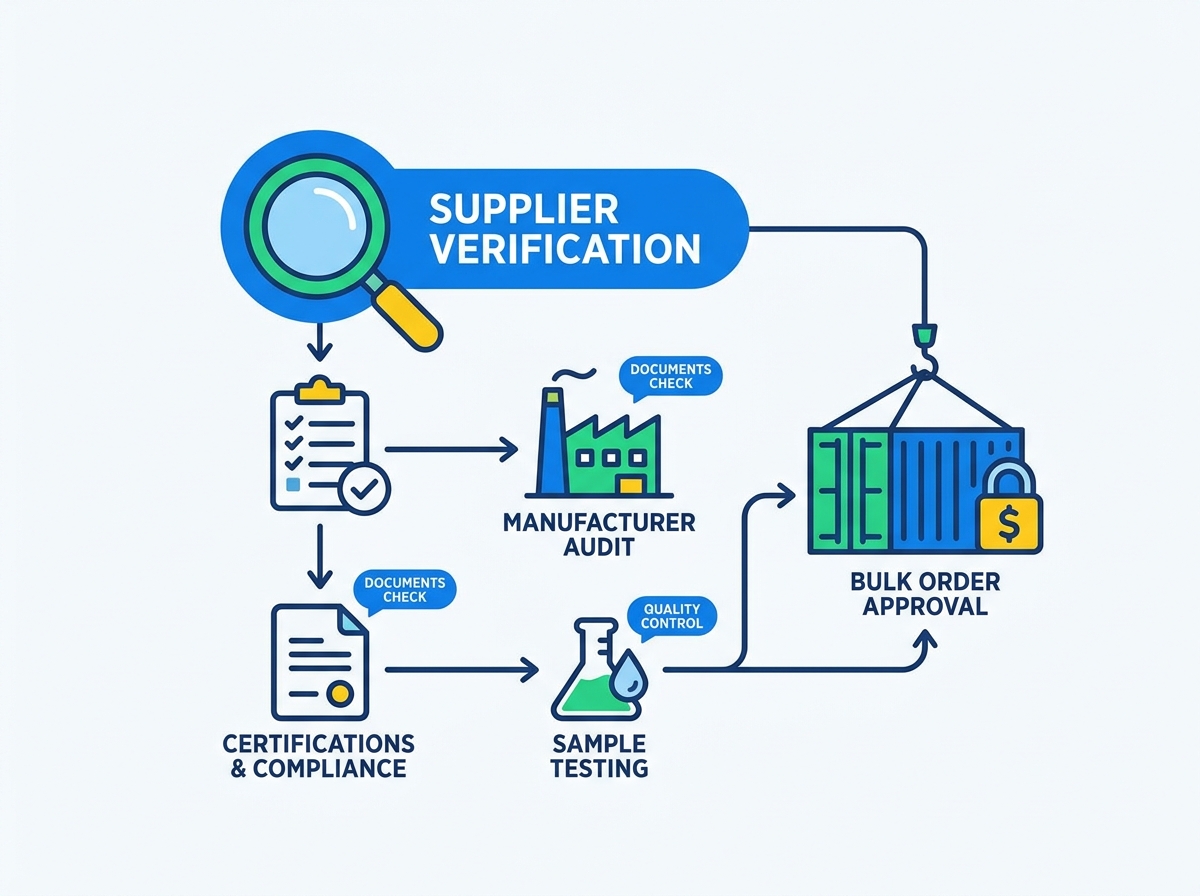
Differentiating between primary manufacturers who handle direct synthesis and distributors or traders is a necessary step. Each category requires distinct documentation to properly vet their operational legitimacy. Manufacturers control the reaction vessels, while traders only control the warehouse. You need to know exactly who you are dealing with to assess supply chain risk accurately.
Certification requirements depend entirely on the application grade. For general quality management in chemical synthesis, ISO 9001 certification is the standard benchmark. This proves the facility has documented procedures for equipment calibration, operator training, and defect management. We always request the actual ISO certificate and verify its validity with the issuing registrar.
If the chemical is sourced for pharmaceutical research, such as antioxidant and anti-inflammatory drug development for diabetes-related complications, the supplier must hold GMP (Good Manufacturing Practice) certification. They must also demonstrate FDA or EMA compliance. These stringent standards ensure the facility operates under strict hygiene and quality controls. A GMP audit involves reviewing their HVAC filtration systems, water purification units, and cross-contamination prevention protocols.
Auditing a supplier's Material Safety Data Sheet (MSDS) reveals their commitment to regulatory compliance and workplace safety. The document must detail specific safety parameters. It should include first-aid measures advising personnel to utilize gentle washing with plenty of soap and water upon contact. Handling precautions and environmental hazard data must be current and reflect the latest regulatory guidelines.
Critical safety instructions regarding specialized conditions must be explicitly stated. This includes hazards associated with its molten state or thermal decomposition products. When heated past 172°C, the compound releases toxic nitrogen oxides. The MSDS must outline the exact ventilation and respiratory protection required during high-temperature processing. A lack of localized or updated safety documentation serves as a major red flag regarding supplier legitimacy.
Transitioning from quality assessment to operational reliability requires focusing on the supplier's ability to meet long-term volume demands without compromising the chemical structure. A supplier might produce a perfect 1kg sample but fail completely when scaling up to a 5-ton order. You must evaluate their heavy machinery and process controls.
Evaluating historical production data and requesting multi-batch CoAs provides a clear picture of manufacturing stability. We look for tight standard deviations across ten consecutive batches. Process chemistry markers are highly revealing. Auditing whether the supplier's synthesis methods consistently yield the standard 63–64% conversion rates of high-purity white solid helps evaluate their synthesis competence and efficiency.
Process validation and adherence to standard operating procedures (SOPs) within the manufacturing facility are mandatory for maintaining this consistency. Ask to see their reactor logs. Check if they monitor temperature and pH continuously during the crystallization phase. Manual interventions often lead to batch variations, whereas automated, PLC-controlled reactors produce uniform material.
Assessing a supplier's true production capacity versus their claimed capacity prevents future supply bottlenecks. Many suppliers overstate their output to win contracts. You need to verify their actual throughput.
Request a complete equipment list, including reactor volumes and centrifuge capacities.
Calculate their maximum theoretical yield based on a standard 24-hour operating cycle.
Compare this theoretical yield against their claimed monthly capacity.
Audit their raw material storage to ensure they hold enough precursors to support continuous production.
Raw material sourcing for the synthesis of the compound directly impacts lead times. If your supplier relies on a single source for their cyanamide or hydrazine hydrate, your supply chain is vulnerable. Evaluating the supplier's inventory management systems and safety stock policies ensures they can absorb market fluctuations and prevent supply chain disruptions during critical production phases.
Logistical and regulatory hurdles often emerge after the purchase order is signed. Proactive risk mitigation ensures the chemical arrives in usable condition. Moving bulk powders across international borders exposes the material to humidity, temperature spikes, and rough handling.
Chemical degradation during transit is a significant risk, particularly given the compound's decomposition profile. Suppliers must guarantee strict packaging requirements. They should utilize moisture-proof, temperature-controlled containers to preserve integrity. We mandate double-lined polyethylene bags sealed inside heavy-duty fiber drums. The outer drum must be shrink-wrapped and palletized to prevent puncture damage during forklift operations.
Upon arrival, the receiving facility must adhere to defined storage conditions. Keep the material in a cool, dry, and well-ventilated area to maintain its shelf life. Warehouse temperatures should remain below 30°C, and relative humidity must be strictly controlled. Install data loggers in the storage area to monitor environmental conditions continuously.
International bulk chemical shipments require precise export and import documentation. A single missing HS code can leave your cargo stranded at the port for weeks. Mitigating customs delays involves verifying the supplier's track record with international trade compliance. Ask for references from other clients in your region.
If applicable to the destination region, confirming REACH registration ensures the shipment will not be impounded or rejected by environmental regulatory bodies. The supplier must provide a comprehensive commercial invoice, a detailed packing list, the verified CoA, and the MSDS formatted to the destination country's specific hazard communication standards.
Financial decision-making in chemical procurement must move beyond evaluating the lowest unit price. You must focus on overall value and risk reduction. Cheap chemicals often carry hidden operational burdens that destroy profit margins.
Buying from spot-market traders often yields variable quality despite lower immediate costs. Traders source from multiple factories, meaning the material profile changes with every delivery. Establishing a long-term agreement with a verified manufacturer requires higher upfront vetting but guarantees stable quality. You lock in a specific synthesis route and a dedicated production line.
Utilizing curated chemical supplier registries helps filter out unverified brokers. Benchmarking candidates against established, registered market players—such as Alpha Chemika, Triveni Interchem, or Joshi Agrochem—helps verify market-standard capabilities and operational reliability. Compare their facility audit scores, lead times, and analytical capabilities to ensure you partner with a top-tier manufacturer.
Verifying a supplier requires a rigorous, multi-tiered approach encompassing chemical analysis, certification audits, and logistical stress-testing. Moving a supplier to the approved vendor list depends on matching CoAs, verified safety documentation, and proven scalability. Do not skip steps in the vetting process.
Request a comprehensive technical data sheet (TDS) and an updated MSDS from the shortlisted candidates.
Mandate a 100g–500g pre-shipment sample for internal laboratory evaluation.
Verify all facility certifications directly with the issuing regulatory bodies.
Establish clear packaging and transit temperature requirements in the final contract.
A: The standard melting point is 172°C, which occurs with decomposition. Deviations from this temperature generally indicate the presence of impurities, poor crystallization, or moisture contamination during the manufacturing process.
A: Laboratories typically use High-Performance Liquid Chromatography (HPLC) and precise titration methods. Modern high-sensitivity assays are also employed to ensure rapid and highly accurate verification of the chemical structure.
A: For pharmaceutical applications, suppliers must hold GMP (Good Manufacturing Practice) certification and comply with FDA or EMA standards to ensure strict quality, hygiene controls, and process validation.
A: It must be stored in moisture-proof, tightly sealed containers within a cool, dry, and well-ventilated area. Temperatures should remain below 30°C to prevent degradation and maintain chemical stability.
A: The MSDS must include first-aid measures like gentle washing with plenty of soap and water, handling precautions, environmental hazards, and specific warnings regarding its molten state and thermal decomposition products.
A: Inconsistent batches introduce trace impurities that disrupt downstream synthesis, alter reaction yields, and cause final product failures. Uniform quality is essential for maintaining continuous, predictable manufacturing operations.
A: Buyers should cross-reference facility certifications, request multi-batch CoAs, utilize independent third-party testing on pre-shipment samples, and audit the supplier's history with international trade compliance and customs documentation.


