
+86-18668977520
+86-18668977520

Views: 0 Author: Site Editor Publish Time: 2026-07-06 Origin: Site


Procurement teams sourcing chemical raw materials frequently fall into a common trap: selecting a supplier based solely on the lowest per-kilogram unit price, only to face compounding downstream costs. When acquiring materials for sensitive applications, minor variances in purity, moisture content, or synthesis byproducts severely disrupt manufacturing processes. Sub-standard batches trigger costly rejections in industries ranging from pharmaceuticals to gas generants, dyes, and agrochemicals.
The operational friction caused by compromised material directly impacts production timelines and final product yields. Evaluating quotes requires a comprehensive framework that looks beyond the initial invoice. This guide provides a technical and logistical lens for assessing suppliers, ensuring procurement teams secure reliable, high-yield materials without sacrificing long-term profitability. By examining synthesis methods, physical property profiles, and supply chain stability, buyers make informed decisions that protect their manufacturing integrity.
Unit Price is a Fraction of Total Procurement Costs: Freight, tariff classifications (HS Code 2928.00), and packaging standards frequently eclipse initial per-kilo savings.
Purity Directly Dictates Downstream Yield: A 1% drop in purity or elevated moisture content can exponentially increase processing times, poison catalysts, and reduce final product yield (e.g., in 5-aminotetrazole/5-ATz synthesis).
Synthesis Methods and Upstream Feedstock Security Matter: Suppliers utilizing modern, one-pot aqueous (green) synthesis and holding secure upstream access to precursors like calcium cyanamide provide superior batch-to-batch consistency and carry lower regulatory supply chain risks.
Documentation and Technical Specifications are Non-Negotiable: Validating Certificates of Analysis (COAs), physical property profiles (such as surface area and heavy atom limits), traceability, and compliance frameworks is critical before committing to a bulk aminoguanidine bicarbonate supply contract.
Establishing a realistic baseline for market evaluations requires looking past aggressive introductory offers. Buyers must analyze the material's performance characteristics and how they interact with specific downstream requirements. A low initial quote often masks deficiencies in material quality that manifest as massive expenses during processing.
There is a distinct operational difference between standard industrial grade (typically 98%) and high-purity grades (99%+). Lower-grade batches often contain unreacted precursors or heavy metal contaminants that necessitate additional purification steps. These mandatory interventions destroy any initial price advantage by increasing labor, energy consumption, and processing time. When you run a reactor, every percentage point of impurity translates to unreacted sludge, fouled equipment, and wasted energy.
Purity directly impacts critical downstream synthesis pathways. When manufacturing 5-aminotetrazole (5-ATz) for gas generants or pharmaceutical intermediates, conversion efficiency relies heavily on the quality of the starting material. Contaminants poison catalysts and alter safety parameters, leading to unpredictable reaction rates and diminished final yields. Heavy metals like iron or lead, even in parts per million, interfere with the catalytic cycles required for tetrazole ring formation.
Purity Grade | Typical Application | Downstream Processing Impact | Catalyst Poisoning Risk |
|---|---|---|---|
98% (Standard Industrial) | Basic dyes, low-tier agrochemicals | Requires filtration of unreacted insolubles | High |
99% (Refined) | Standard gas generants | Minimal filtration, standard reaction times | Moderate |
99.5%+ (High Purity) | Pharmaceutical intermediates, advanced airbags | Direct addition to reactor, high yield | Very Low |
The chemical stability of C2H8N4O3 is highly sensitive to environmental factors. Excessive moisture accelerates degradation, effectively reducing the amount of active material per ton purchased. You are essentially paying freight for water. High moisture levels also cause caking during transit and storage, transforming free-flowing powder into solid blocks.
Caked material requires mechanical breaking before it can be introduced into reactors, leading to handling inefficiencies and processing delays. Operators must spend hours manually crushing the material, exposing them to dust and slowing down batch cycle times. Strict moisture control is essential to maintain the structural integrity and reactivity of aminoguanidine bicarbonate throughout its shelf life.
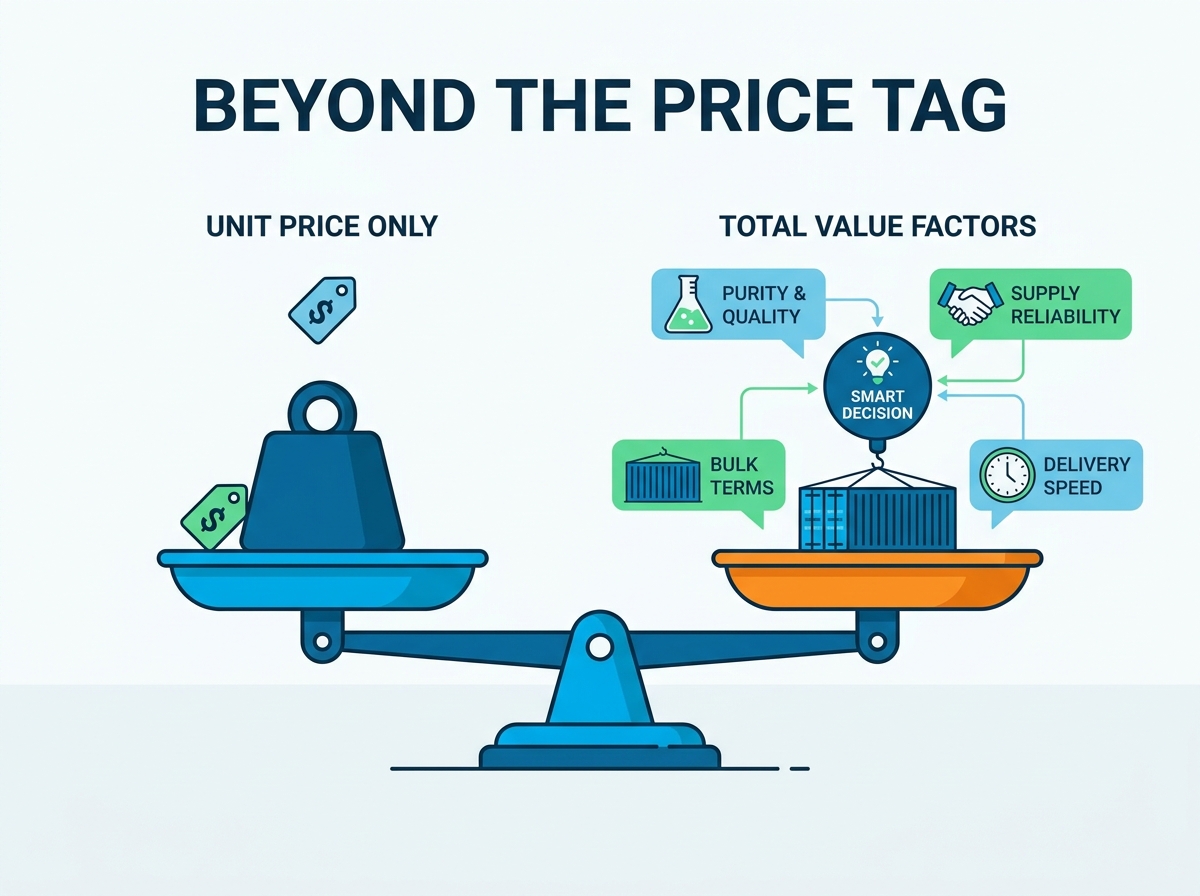
A supplier's manufacturing technology and supply chain integration are strong indicators of their long-term reliability and product consistency. You cannot evaluate a chemical supplier without understanding how they make the molecule and where they get their raw materials.
Legacy manufacturing processes often struggle with impurity management and environmental waste. These older methods typically involve multiple isolation steps that introduce opportunities for contamination and yield loss. In contrast, modern one-pot aqueous reactions offer a streamlined approach. These advanced synthesis methods yield a more consistent crystalline structure, minimize residual salt content, and generate significantly fewer toxic byproducts, resulting in a cleaner final product.
The crystalline structure directly affects how the material handles in your facility. A well-defined crystal habit flows easily through hoppers and dissolves predictably in aqueous or organic solvents. Poorly synthesized material with irregular crystal structures tends to agglomerate and dissolve unevenly, causing localized concentration spikes in your reactors.
Evaluating a supplier requires understanding their access to primary precursors, particularly calcium cyanamide and hydrazine. Supply shocks in raw calcium cyanamide directly correlate with sudden escalations or force majeure declarations further down the chain. Suppliers with integrated precursor manufacturing or robust, long-term contracts offer far greater stability.
Hydrazine hydrate is another critical bottleneck. Because it is a hazardous material with strict transport regulations, suppliers who do not produce it on-site or lack a pipeline from a neighboring facility are highly vulnerable to logistics disruptions. When auditing a supplier, map their raw material sources. If they buy precursors on the spot market, your supply chain is at risk.
A supplier's environmental footprint impacts long-term supply stability. Manufacturers facing strict local environmental crackdowns on hazardous effluents are high-risk for sudden shutdowns. Partnering with facilities that utilize modern synthesis and maintain rigorous compliance protocols minimizes the risk of sudden supply interruptions. Effluent treatment capabilities are a direct proxy for operational longevity.
Evaluating the true financial impact of a supply contract requires analyzing logistics, tariffs, and material protection strategies. The ex-works quote is just the starting point of the calculation.
Shipping terms such as FOB, CIF, or DDP drastically alter the final landed cost. Accurate documentation is paramount. The material falls under HS Code 2928.00 (organic chemicals). Incorrect classifications or missing paperwork lead to severe customs delays, unexpected import duties, and supply chain bottlenecks. Customs officials will hold containers for weeks if the chemical nomenclature and HS codes do not perfectly match the commercial invoice and the packing list.
Demurrage charges at the port can quickly erase any savings gained from a cheaper unit quote. Procurement teams must work closely with freight forwarders to ensure all safety data sheets (SDS) and certificates of origin are verified before the vessel departs the origin port.
Inadequate packaging leads to product loss and moisture absorption during maritime transit and warehousing. This inflates the real cost per usable kilogram. Hygroscopic chemicals shipped across the ocean experience massive temperature and humidity swings. If the packaging fails, the material degrades before it even reaches your warehouse.
Packaging Type | Moisture Protection | Transit Durability | Best Use Case |
|---|---|---|---|
Standard Woven Bags (25kg) | Low | Moderate | Short-distance, immediate use |
PE-Lined Woven Bags (25kg) | Moderate | High | Standard domestic transport |
Multi-layer Fiber Drums with Inner Liners | High | Very High | Long-haul maritime transit, extended storage |
FIBC Bulk Bags (1000kg) with Foil Liner | Very High | High | High-volume continuous manufacturing |
Establishing a reliable supply chain requires rigorous vetting of potential manufacturing partners against strict technical and operational standards. Do not rely on marketing brochures; demand hard data and conduct physical audits when possible.
Buyers must read a Certificate of Analysis (COA) critically. Look beyond the top-line purity number to examine the assay methods utilized, the loss on drying (LOD) metrics, and the specific impurity profiles. Consistent COAs across multiple batches indicate a controlled manufacturing environment. If the purity fluctuates between 98.1% and 99.8% from batch to batch, the supplier lacks process control.
Verify the assay methodology (e.g., HPLC vs. Titration).
Check the Loss on Drying (LOD) limit (should be strictly <0.5%).
Review the heavy metal content (Pb, Fe) to ensure it meets your catalyst tolerance limits.
Confirm the ash content/residue on ignition.
Assess key structural and physical property parameters relevant to high-performance applications. Verify surface area specifications, typically targeting approximately 148 Ų molecular polar surface area profiles for specific formulation solubility. Confirm formal charge neutrality and strict heavy atom count limits to ensure predictable reactivity in downstream processes. Particle size distribution (PSD) also plays a massive role in dissolution rates; request PSD data alongside the standard COA.
Assess the supplier's capacity to hold domestic buffer stock. Relying entirely on just-in-time international freight introduces significant risk. A supplier capable of maintaining local inventory provides a critical safety net against global shipping disruptions. Ask potential partners about their warehousing footprint in your region and their standard inventory turnover rates.
Require verifiable proof of ISO 9001 certification. If applicable to the specific downstream industry, demand cGMP compliance documentation to ensure all manufacturing processes meet stringent quality control standards. A robust QMS ensures that when deviations occur, they are documented, investigated, and corrected systematically rather than hidden from the buyer.
Evaluate the supplier's responsiveness to technical queries. A professional supplier will have a formal, transparent process for handling out-of-spec (OOS) material claims, demonstrating accountability and a commitment to long-term partnerships. If a batch fails your incoming quality control (IQC), you need a partner who will immediately send a replacement and initiate a root cause analysis, not one who argues over testing methodologies.
Proactive risk management is essential when integrating a new chemical supplier into existing manufacturing workflows. Transitioning suppliers always carries inherent operational risks that must be managed systematically.
Mitigation: Lock in quarterly or bi-annual contracts with clear indexing to key precursor costs, such as calcium cyanamide, to stabilize forecasting and protect profit margins. Establish currency collars if purchasing in foreign denominations to prevent sudden margin erosion due to exchange rate shifts.
Mitigation: Formulate a dual-sourcing strategy. Qualify a primary overseas manufacturer for volume requirements and establish a relationship with a secondary domestic distributor for emergency buffer stock. Never allow a single facility to control 100% of your raw material pipeline.
Mitigation: Mandate a structured sampling protocol. Move systematically from lab-scale samples (100g) to pilot-scale trials (25kg) to test conversion rates into intermediates like 5-ATz before authorizing full commercial bulk orders. A material that performs perfectly in a glass beaker may behave entirely differently in a 5000-liter stainless steel reactor due to heat transfer and agitation variables.
The true cost of procuring chemical raw materials is measured at the end of the production line, not on the initial proforma invoice. Evaluating suppliers requires a holistic approach that prioritizes material quality, supply chain security, and logistical efficiency.
Request a comprehensive technical data sheet (TDS) and a sample COA from the prospective supplier.
Order a 25kg pilot sample to run a scale-up test in your specific downstream reactor environment.
Audit the supplier's upstream precursor contracts and local warehousing capabilities.
Establish a dual-sourcing agreement to protect against unforeseen logistics bottlenecks.
A: The correct classification is HS code 2928.00 under Chapter 29 for organic chemicals. Always check local tariff schedules for specific import duties applicable to your region.
A: High moisture leads to caking, handling difficulties, and potential chemical degradation. Strict Loss on Drying (LOD) limits on the COA are necessary to ensure material viability.
A: One-pot aqueous reactions reduce impurities, lower the environmental impact, and significantly decrease the risk of the supplier facing regulatory shutdowns due to hazardous waste violations.
A: Highlight the purity percentage, moisture content/LOD, heavy metal limits, specific physical parameters like surface area properties, and the exact assay methodology used to verify the results.
A: Calcium cyanamide is a key upstream precursor used in its synthesis. Supplier integration or strong contracts with calcium cyanamide producers insulate buyers from sudden supply volatility.
A: Impurities, excessive moisture, or residual heavy metals in lower-grade material can poison catalysts and dramatically lower reaction yields during the synthesis of 5-ATz, increasing operational costs.
A: Cheap woven bags invite moisture ingress and caking. Robust fiber drums or PE-lined bags protect the chemical integrity and reactivity during long-haul transit and extended warehousing.


