
+86-18668977520
+86-18668977520

Views: 0 Author: Site Editor Publish Time: 2026-07-26 Origin: Site


Supply chain disruptions in specialty chemical procurement carry compounding costs. When sourcing highly specific intermediates like aminoguanidine bicarbonate, unpredictable lead times and rigid production capacities severely disrupt downstream manufacturing schedules. Industries relying on this compound, such as pharmaceuticals and agrochemicals, face inflated inventory holding costs when supply chains falter. Unreliable delivery schedules force manufacturers to hold excess safety stock, tying up capital. Conversely, running lean risks production halts if a supplier misses a delivery window. Securing a stable supply requires moving beyond basic price comparisons. Buyers must technically evaluate a supplier’s synthesis methods, precursor sourcing pathways, capacity utilization, and lead-time mitigation strategies. We need to look at the actual reactor capabilities, raw material pipelines, and drying infrastructure to understand true capacity and avoid costly delays.
Synthesis Dictates Scale & Precursor Risk: Choosing between the hydrazine hydrate-lime nitrogen pathway and the nitroguanidine-zinc reduction pathway determines both the supplier's environmental compliance exposure and precursor-related lead-time risks.
Thermal Constraints Control Throughput: The drying phase of aminoguanidine bicarbonate is a strict chemical bottleneck; exceeding temperature thresholds causes thermal decomposition, meaning capacity cannot be forced without advanced atmospheric drying technology.
The Lead Time Breakdown: Standard chemical lead times are comprised of five distinct components—queue, setup, run, wait, and move/QA—which must be optimized by a bulk aminoguanidine bicarbonate supplier to achieve 30-50% cycle-time reductions.
The Efficiency Paradox: While maximal capacity utilization lowers unit costs through optimized conversion and recovery rates, buyers must partner with suppliers who maintain a calculated capacity buffer to absorb sudden demand spikes.
Efficient, scalable production of aminoguanidine bicarbonate requires high conversion rates, maximum recovery, minimal environmental waste processing delays, and stable dry-cake yields. A supplier's chosen chemical pathway directly dictates their baseline production capacity and ability to scale operations reliably. You cannot evaluate a chemical manufacturer without understanding the exact chemistry happening inside their reactors. The synthesis route determines how fast a batch can be completed and what raw materials might cause a bottleneck.
The industrial standard often utilizes hydrazine hydrate, lime nitrogen (calcium cyanamide), sulfuric acid, and ammonium bicarbonate. Regulatory pressures on hydrazine chemistry can affect global supply continuity. Environmental compliance costs associated with handling toxic intermediates can also slow down batch processing. Facilities using this route must maintain strict safety protocols, which inherently limits how fast they can push material through the plant.
An alternative process involves the reduction of nitroguanidine in a water suspension with dissolved ammonium sulfate and zinc powder. These chemical pathways differ significantly in yield, processing complexity, and raw material dependence. A supplier relying heavily on imported hydrazine hydrate faces different lead-time risks than one utilizing the nitroguanidine reduction route. Zinc powder availability and pricing fluctuate based on metallurgical markets, adding a different layer of supply chain complexity. Procurement teams must map these upstream dependencies to understand where the next shortage might originate.
The transition to modern, green, one-pot aqueous reactions eliminates toxic intermediate isolation. Reducing step-by-step intermediate handling minimizes cycle times. This approach increases overall batch capacity and reduces hazardous waste-disposal bottlenecks. When a plant does not have to stop, isolate an intermediate, clean the reactor, and restart the next phase, throughput increases dramatically.
By streamlining the reaction process, manufacturers can process more batches per month. This method also lowers the environmental compliance burden, allowing facilities to operate with fewer regulatory interruptions. Less time spent managing hazardous waste means more time dedicated to active product synthesis. Suppliers utilizing one-pot methods generally offer more stable lead times because they have fewer operational steps that can fail.
Drying a wet cake of aminoguanidine bicarbonate presents significant technical realities. Precise temperature controls are mandatory. Excessive heat triggers decomposition of the bicarbonate structure, compromising compound purity. You cannot simply turn up the heat to dry the product faster. The chemical structure will break down, resulting in a failed batch and wasted raw materials.
A supplier's drying technology infrastructure directly limits or expands daily throughput. Standard atmospheric drying is slow and carries higher thermal degradation risks. Vacuum drying and specialized inert atmospheres allow for faster moisture removal at lower temperatures, effectively removing a major production bottleneck. When auditing a facility, the drying ovens are often the true indicator of maximum capacity, regardless of how large the reaction vessels are.
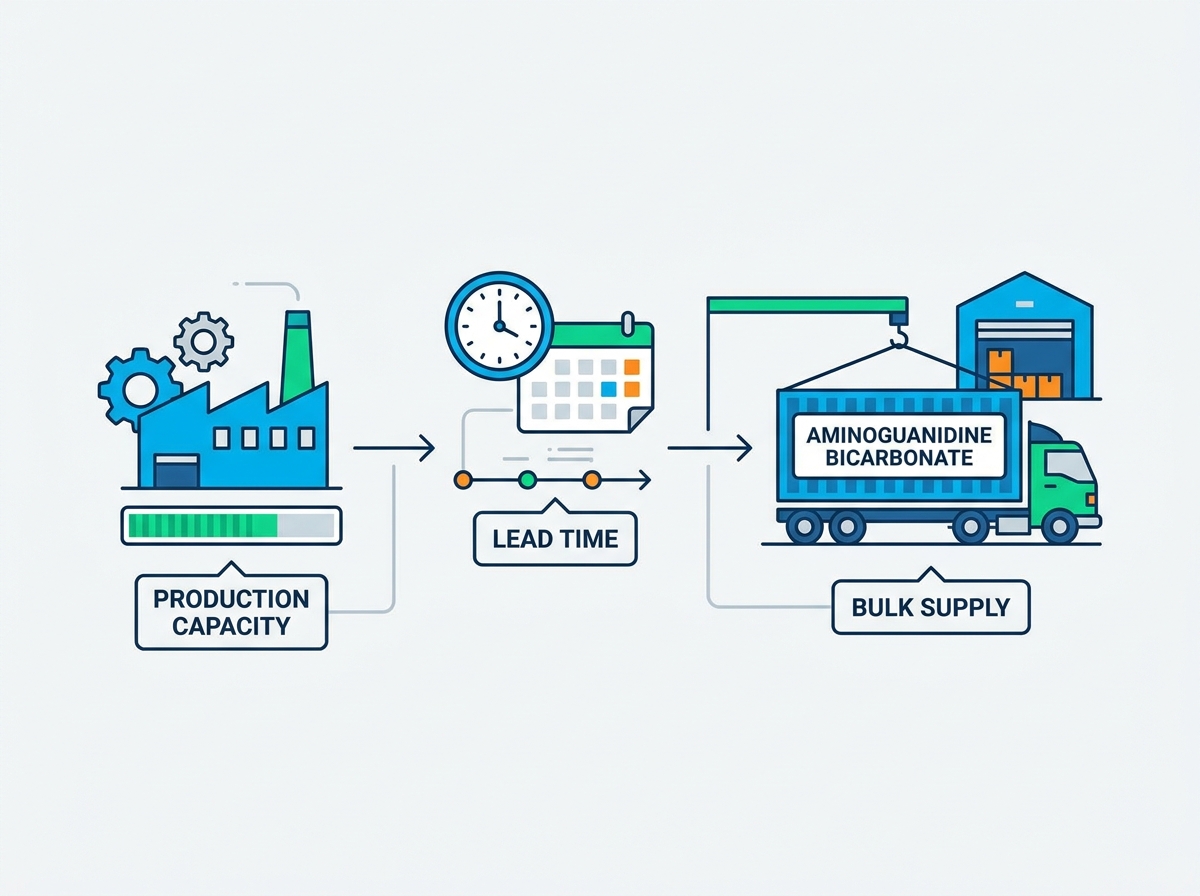
Breaking down the manufacturing timeline helps procurement teams identify where structural delays occur. This evaluation allows buyers to assess supplier scheduling efficiency accurately. You need to know exactly how long each step takes to spot inefficiencies in a supplier's operation.
Chemical lead times consist of several distinct phases. Understanding these phases allows you to challenge a supplier's quoted delivery times.
Queue/Scheduling Time: Capacity-based work scheduling prevents batch backlog. If a supplier has poor scheduling software, your order sits idle before production even begins.
Setup Time: Reactor cleaning, vessel preparation, and precursor staging protocols take time. Efficient plants use dedicated lines to minimize cross-contamination cleaning delays.
Run Time: Chemical reaction times, conversion rates, and precipitation duration are fixed by the chemistry. However, optimized agitation and temperature control can shave hours off this phase.
Wait Time: The critical cooling, filtration, wet cake recovery, and drying cycles often take longer than the reaction itself. Filtration bottlenecks are common in older facilities.
Move & QA Release Time: Transportation to cleanrooms, analytical testing, packaging, and regulatory sign-offs. In-house testing labs drastically reduce this final delay.
Assessing the supply chain stability of primary precursors is essential. Hydrazine hydrate, zinc powder, ammonium sulfate, and nitroguanidine all face market volatility. A supplier's upstream backward integration or raw material stocking policies insulate the production schedule from market-wide precursor shortages. If your supplier buys raw materials on the spot market, your lead times will be highly unpredictable.
Suppliers who maintain strategic reserves of critical precursors can maintain production schedules even during global supply crunches. This capability is a critical differentiator when evaluating long-term partners. Ask potential suppliers about their inventory holding policies for raw materials, not just finished goods.
Transitioning from traditional batch processing steps toward continuous or semi-continuous processing components affects overall delivery timelines. Capacity-based scheduling models reduce non-productive lead times significantly. Advanced manufacturers use predictive maintenance to ensure equipment does not fail mid-batch.
By optimizing setup and wait times, manufacturers can achieve faster turnaround times. This efficiency translates to more reliable delivery schedules for downstream buyers. Look for suppliers who actively invest in debottlenecking their production lines.
Procurement teams must balance operational cost efficiencies with supply chain resilience. Evaluating a supplier requires looking beyond theoretical capacities and examining their operational realities. A low price is useless if the product arrives three weeks late.
There is a distinct difference between a facility's theoretical nameplate capacity and its utilized production capacity. Maximizing capacity utilization through high conversion, recovery, and purification rates is necessary to lower the per-kilogram price. Plants running at high efficiency spread their fixed costs over more units.
However, operating at 100% capacity leaves zero margin for equipment downtime, delayed raw material shipments, or sudden demand spikes. Finding the optimal sweet spot, typically around 80-85% utilization, ensures the supplier remains agile enough to handle unexpected disruptions. A supplier running at maximum capacity is a supply chain failure waiting to happen.
Critical analytical testing requirements include HPLC purity profiling, moisture content analysis, and ash content verification before batch release. Rigorous QA processes add to lead time but prevent downstream manufacturing failures. You cannot afford to put off-spec material into your own production lines.
Costly regulatory non-compliance can halt production entirely. A supplier with robust in-house testing capabilities ensures that every batch meets strict purity standards without requiring excessive third-party testing delays. Verify that their lab equipment is calibrated and modern.
Supplier-held safety stock and vendor-managed inventory arrangements mitigate raw manufacturing lead times. Regional warehousing allows for faster delivery to repeat bulk buyers. Having material sitting in a warehouse near your facility is the ultimate lead time reduction strategy.
These inventory strategies provide a buffer against production delays. Buyers should evaluate a supplier's warehousing footprint and their willingness to hold dedicated safety stock. Negotiate these terms upfront during the contracting phase.
Onboarding a new chemical supplier involves practical challenges. Establishing supply chain security requires proactive risk management. You must anticipate failures before they occur.
Global pricing fluctuations for hydrazine, zinc, and ammonium salts pose significant risks. Mitigation tactics include utilizing dual-sourcing chemistry options, where suppliers are capable of both major synthesis routes. This flexibility allows them to pivot if one raw material becomes scarce.
Long-term rolling forecasts and indexed pricing mechanisms also help stabilize costs. These strategies protect buyers from sudden price spikes in the raw material market. Tie your contract pricing to public commodity indices to ensure fairness.
Procurement teams should conduct thorough technical capacity and facility audits. Verify reactor volume capacities and drying oven heat distribution controls. Do not take a sales brochure at face value; inspect the equipment.
Check for analytical instrumentation redundancy, such as backup HPLC and GC machines. Reviewing historical on-time in-full delivery logs provides concrete evidence of a supplier's reliability. A well-maintained plant usually indicates a well-managed production schedule.
Evaluation Area | Key Metrics to Audit | Red Flags |
|---|---|---|
Synthesis Route | Precursor dependency, environmental compliance record | Single-source raw material reliance |
Drying Technology | Vacuum vs. atmospheric, temperature control precision | Lack of automated temperature monitoring |
Capacity Utilization | Current utilization rate, buffer capacity for demand spikes | Operating above 95% capacity consistently |
Quality Assurance | In-house HPLC/GC availability, average QA release time | Outsourcing all batch release testing |
Reliable aminoguanidine bicarbonate supply depends on more than a supplier’s stated annual capacity or quoted lead time. Buyers must understand how the selected synthesis route, precursor availability, reactor scheduling, filtration, drying technology, and quality-release procedures affect actual production throughput.
Drying is particularly important because thermal sensitivity limits how quickly moisture can be removed without compromising product quality. Suppliers with controlled vacuum-drying systems, in-house analytical testing, and sufficient equipment redundancy are generally better positioned to maintain consistent output.
Capacity utilization should also leave enough operational margin for maintenance, raw material delays, and unexpected demand. Evaluating historical delivery performance, precursor sourcing, warehousing capabilities, and available safety stock provides a more realistic picture of supply reliability. The strongest supplier combines efficient production with transparent capacity planning and sufficient flexibility to manage disruption.
A: Typical batch timelines range from 4 to 8 weeks. This duration factors in reaction, filtration, drying, and QA release, depending heavily on raw material readiness and the supplier's current capacity utilization.
A: Drying is a major bottleneck. Aminoguanidine bicarbonate is sensitive to heat and will decompose if temperatures are too high. Advanced vacuum drying allows for faster moisture removal at lower temperatures, increasing throughput.
A: While high utilization lowers unit costs, a supplier operating at 100% capacity cannot absorb demand spikes or equipment downtime. A buffer of 15-20% ensures supply agility and prevents missed deliveries.
A: The two primary routes are the traditional hydrazine hydrate-lime nitrogen pathway and the nitroguanidine-zinc reduction pathway. Modern facilities are also adopting green one-pot aqueous reactions to improve efficiency.
A: Buyers should look for suppliers with upstream backward integration, strategic raw material reserves, or the capability to utilize multiple synthesis routes to avoid reliance on a single volatile precursor.


