
+86-18668977520
+86-18668977520

Views: 0 Author: Site Editor Publish Time: 2026-07-16 Origin: Site


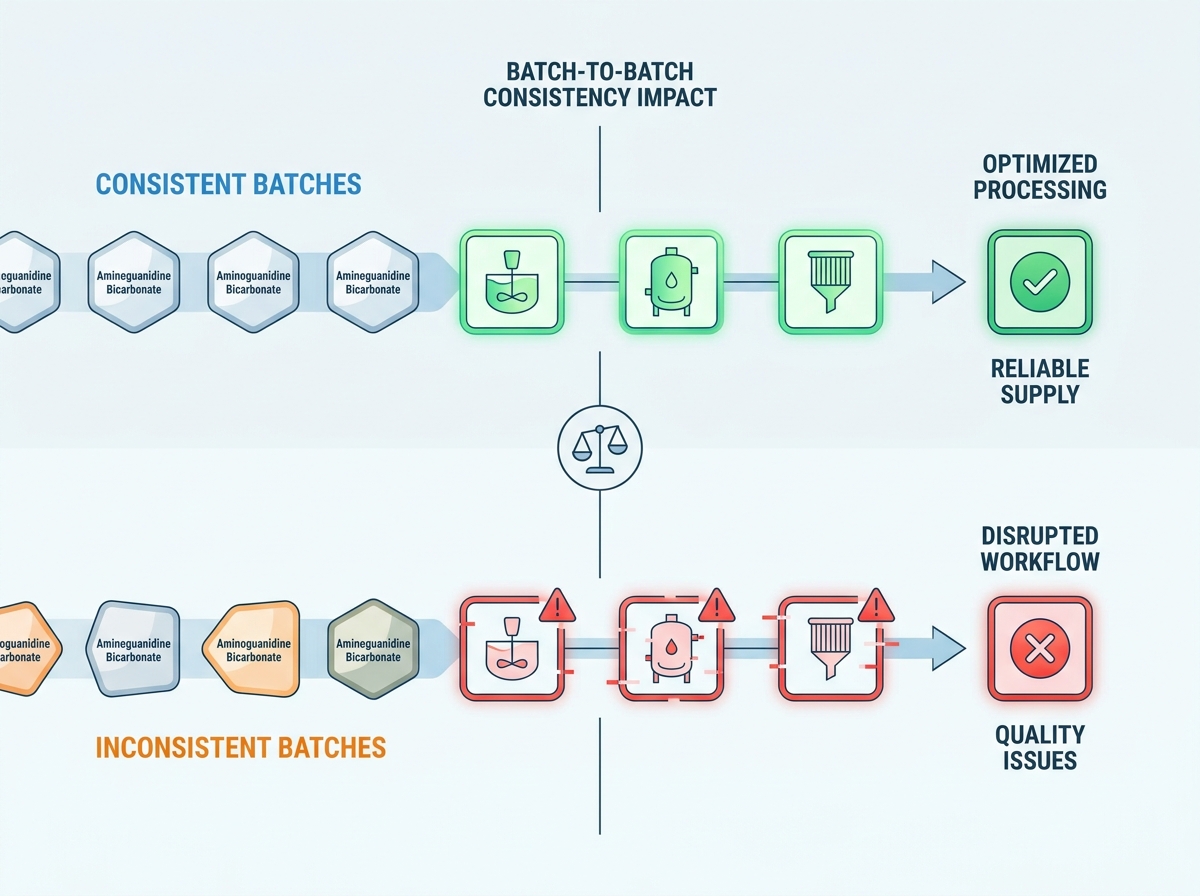
Raw material variability compounds financial and operational costs across chemical manufacturing facilities. This reality hits hardest when dealing with sensitive intermediate compounds where minor fluctuations in aminoguanidine bicarbonate specifications cause unpredictable reaction kinetics. Variables like moisture content, chemical purity, and particle size dictate downstream success. When these metrics drift, plant managers face off-spec downstream products, blocked transfer lines, and costly process interruptions. We must shift our focus from reactive quality control to proactive procurement strategies. Reworking failed batches drains resources, consumes excess energy, and delays production schedules. Standardizing input variables remains the most effective method for protecting margins. This proactive approach ensures strict regulatory compliance across production runs and stabilizes overall plant throughput.
Inconsistent aminoguanidine bicarbonate batches directly impact downstream yield, increasing byproduct formation and necessitating expensive purification steps.
Physical properties, particularly Particle Size Distribution (PSD) and moisture content, are as critical as chemical purity for maintaining predictable reaction rates.
Evaluating a supplier's Quality Management System (QMS) and historical Certificate of Analysis (CoA) data is mandatory for mitigating supply chain risks.
Securing a reliable aminoguanidine bicarbonate supply reduces equipment downtime, lowers material waste, and ensures compliance in strictly regulated industries like pharmaceuticals and agrochemicals.
This compound functions as a critical intermediate across multiple manufacturing sectors. Facilities use it to synthesize active pharmaceutical ingredients, complex dyes, and specialized agricultural products. Each application demands specific performance characteristics from the raw material. The molecular structure allows it to participate in diverse condensation and ring-closure reactions. This versatility makes it indispensable for synthesizing triazoles and tetrazoles. Downstream product integrity relies heavily on the initial quality of this precursor. When synthesizing photographic chemicals, even parts-per-million trace impurities can ruin the final product's performance.
Successful processing requires establishing strict baseline metrics on the plant floor. Plant managers monitor target yield percentages to evaluate reaction efficiency. Acceptable impurity thresholds must remain well below regulatory limits. Required reaction cycle times dictate overall plant throughput and capacity planning. Operators rely on consistent raw materials to hit these operational targets. When input variables stabilize, the entire synthesis process becomes highly predictable. This predictability allows facilities to optimize energy consumption and labor allocation.
Target yield percentages must consistently exceed 95% to maintain process economics.
Impurity thresholds for heavy metals must remain below 10 ppm.
Reaction cycle times should not deviate by more than 5% between batches.
Filtration times during downstream isolation must remain consistent to prevent bottlenecks.
This intermediate exhibits high sensitivity to minor quality deviations. Its specific chemical structure and reactivity profile demand tight tolerances. Unlike stable bulk commodities, it reacts rapidly to environmental and chemical changes. Slight variations in batch quality alter reaction kinetics significantly. This sensitivity requires precise control over synthesis parameters during downstream processing. Even trace contaminants can poison catalysts or alter stoichiometric balances. Manufacturers must treat this compound with strict quality oversight to prevent cascading failures.
Trace impurities catalyze unwanted side reactions during synthesis. Unreacted precursors or heavy metals often trigger these competing chemical pathways. These side reactions consume valuable reagents and reduce the target active ingredient yield. Increased byproduct formation complicates downstream purification steps. Facilities must deploy additional filtration or chromatography stages to isolate the desired product. This extra processing consumes time, energy, and expensive solvents. Maintaining high purity prevents these cascading operational failures and keeps the plant running on schedule.
Varying moisture levels drastically impact material flowability. High moisture causes the powder to cake inside storage hoppers and transfer lines. This caking leads to inaccurate dosing during automated feeding sequences. Inaccurate dosing alters the stoichiometric ratios required for optimal synthesis. Excess water can also trigger premature hydrolysis in sensitive reaction environments. Operators must frequently halt production to clear blockages and recalibrate feeders. Controlling moisture is essential for continuous, uninterrupted processing.
Particle size directly controls the material dissolution rate inside the reactor. Inconsistent PSD causes localized concentration gradients within the solvent. Fine particles dissolve rapidly, while larger agglomerates react slowly. This disparity leads to incomplete reactions and lower overall yields. In exothermic processes, uneven dissolution can trigger dangerous thermal runaway events. Consistent particle sizing ensures smooth, predictable heat generation during synthesis. Plant engineers rely on uniform PSD to design safe cooling protocols.
Subtle shifts in powder color serve as critical early warning indicators. Quality teams monitor these changes using precise spectrophotometry equipment. Discoloration often signals precursor oxidation or trace metal contamination. Residual zinc or iron frequently causes these aesthetic variations. If ignored, these contaminants will discolor downstream dye formulations. They can also compromise the visual quality of pharmaceutical actives. Catching color variance early prevents large-scale batch rejections.
Different synthesis methods produce distinct impurity profiles. One common method involves reducing nitroguanidine in water suspensions. This process utilizes zinc powder and ammonium sulfate to drive the reaction. Another pathway relies on the condensation of cyanamide with hydrazine salts. Each method introduces specific downstream processing challenges. The reduction method often leaves residual zinc and sulfate salts. The condensation method can introduce unreacted hydrazines into the final product. Understanding the synthesis pathway helps predict potential quality issues.
The purity of upstream precursors dictates final product quality. Manufacturers must source high-grade nitroguanidine or cyanamide to ensure success. Contaminants in these starting materials carry through the entire synthesis process. Poor quality precursors lead to elevated impurity levels in the final intermediate. Facilities cannot easily remove these embedded contaminants through standard washing steps. Strict supplier qualification for upstream materials prevents downstream quality failures. Quality begins at the very start of the chemical supply chain.
Manufacturers must strictly control several critical manufacturing variables. Temperature control prevents unwanted thermal degradation during synthesis. pH stabilization ensures the reaction proceeds along the correct chemical pathway. Controlled crystallization rates prevent problematic polymorphic variations. Rapid cooling often traps impurities within the crystal lattice structure. Slow, controlled crystallization yields purer, more uniform particles. Mastering these parameters ensures consistent lot-to-lot quality.
Improper drying techniques cause severe lot-to-lot variance. Excessive heat during drying degrades the compound and alters its chemical structure. Inadequate drying leaves residual moisture that promotes caking. Packaging also plays a crucial role in maintaining material integrity. Inadequate moisture-barrier packaging allows humidity to penetrate during transit. This exposure leads to degradation before the material even reaches the processing facility. Robust packaging protocols protect the material during storage and shipping.
Low-purity inputs drain financial resources rapidly. Operators must over-charge reactants to compensate for degraded raw materials. This over-charging wastes expensive chemicals and reduces overall process efficiency. Failed downstream batches require labor-intensive recrystallization steps. These rework procedures consume massive amounts of energy and facility time. The hidden costs of poor quality quickly erode manufacturing profit margins. Getting the chemistry right the first time is always more cost-effective.
Inconsistent physical properties wreak havoc on automated systems. Caking materials block pneumatic transfer lines and volumetric feeders. These blockages force operators to halt production lines for manual intervention. Maintenance teams must disassemble equipment to clear hardened powder accumulations. This unplanned downtime severely impacts plant capacity and delivery schedules. Frequent clean-outs also increase the risk of cross-contamination between batches. Reliable physical properties keep automated equipment running smoothly.
Batch variability introduces severe risks in pharmaceutical applications. Regulatory agencies demand strict adherence to Good Manufacturing Practice (GMP) standards. Inconsistent intermediates lead to failed audits and rejected final product lots. Out-of-specification results trigger lengthy, expensive internal investigations. Repeated compliance failures can result in facility shutdowns or product recalls. Maintaining tight control over raw materials is a regulatory necessity. Compliance depends entirely on predictable, documented chemical inputs.
Procurement teams must evaluate potential suppliers rigorously. You should assess their statistical process control (SPC) capabilities first. Verify their adherence to recognized ISO and GMP manufacturing standards. Request historical data demonstrating their ability to maintain tight process tolerances. A robust QMS indicates a supplier's commitment to long-term quality. Physical site audits provide valuable insights into their operational discipline. Never rely solely on marketing claims when qualifying chemical suppliers.
Do not accept broad commercial-grade specifications for sensitive processes. Procurement and QA teams must negotiate strict tolerance limits. Define exact parameters for chemical purity, moisture content, and PSD. Ensure the Certificate of Analysis reflects these customized, tighter specifications. Reject shipments that fall outside these negotiated boundaries immediately. Strict CoA enforcement prevents substandard materials from entering your facility. Clear specifications eliminate ambiguity during incoming quality inspections.
Partner with manufacturers who utilize advanced automation. Automated process control loops stabilize chemical synthesis parameters in real-time. This technology minimizes human-error-induced batch variance significantly. Sensors monitor temperature, pH, and dosing rates continuously. The system adjusts variables instantly to maintain optimal reaction conditions. High automation maturity guarantees a more consistent final product. Manual batch processing simply cannot match automated precision.
Procurement must balance risk mitigation with quality assurance. Dual-sourcing protects against sudden supply chain disruptions. However, managing multiple suppliers complicates quality standardization efforts. Developing a deep partnership with a single high-quality manufacturer offers distinct advantages. This approach ensures a highly consistent and reliable aminoguanidine bicarbonate supply. Strategic partners will often customize their processes to meet your specific needs. Evaluate your facility's risk tolerance when choosing a sourcing strategy.
Robust IQC testing verifies CoA claims before materials enter production. Facilities must deploy specific analytical techniques for accurate verification. High-Performance Liquid Chromatography (HPLC) confirms chemical purity and identifies trace organics. Karl Fischer titration provides precise moisture content measurements. Laser diffraction equipment maps the exact Particle Size Distribution. These tests prevent off-spec materials from ruining large production runs. Trust the supplier, but always verify the chemistry internally.
Parameter | Analytical Method | Processing Impact |
|---|---|---|
Chemical Purity | HPLC | Prevents side reactions and byproduct formation. |
Moisture Content | Karl Fischer Titration | Ensures accurate dosing and prevents hopper caking. |
Particle Size (PSD) | Laser Diffraction | Maintains consistent dissolution and reaction kinetics. |
Trace Metals | ICP-MS | Prevents catalyst poisoning and color degradation. |
Downstream processors can leverage advanced statistical tools. Multivariate statistical process control (MSPC) evaluates lot-to-lot similarity mathematically. Chemometrics moves beyond simple binary pass/fail limits. These techniques analyze entire chromatographic fingerprints to catch subtle trend drifts. Early detection of drifting quality allows for proactive process adjustments. This mathematical approach provides a deeper understanding of raw material variance. It transforms raw analytical data into actionable manufacturing intelligence.
Process analytical technology (PAT) tools revolutionize quality monitoring. Inline Near-Infrared (NIR) spectroscopy monitors raw material uniformity in real-time. These non-destructive sensors operate without disrupting current plant workflows. They provide continuous data streams regarding moisture and blend uniformity. Tight sampling loops catch deviations before they impact the entire batch. Implementing PAT reduces reliance on delayed laboratory testing results. Real-time data empowers operators to make immediate process corrections.
Facilities can adapt to slight, acceptable deviations in raw materials. Advanced process control (APC) systems adopt closed-loop engineering strategies. Operators can dynamically adjust mixing times to accommodate varying particle sizes. Temperature profiles can be tweaked to manage altered dissolution rates. Reactant ratios can be recalibrated based on exact purity assays. These practical adjustments salvage batches that might otherwise fail. Flexibility in processing parameters maximizes overall plant yield.
Proper facility storage prevents material degradation over time. Store this compound in strict climate-controlled environments. Maintain low humidity levels to prevent moisture absorption and caking. Implement strict First-In, First-Out (FIFO) inventory rotation protocols. Keep containers tightly sealed until immediately before processing. Store the material away from strong oxidizing agents and direct sunlight. Excellent storage practices preserve the quality you worked hard to procure.
Batch-to-batch consistency in aminoguanidine bicarbonate is a fundamental requirement for viable, scalable chemical synthesis. Unpredictable raw materials destroy profit margins and introduce severe compliance risks. Standardizing this critical input protects your downstream processes and final product quality.
Audit your current aminoguanidine bicarbonate specifications against actual process requirements.
Implement rigorous IQC testing for the next three deliveries to verify supplier CoA claims.
Initiate dialogue with suppliers regarding a long-term reliability agreement based on SPC data.
Upgrade storage facilities to ensure strict climate control and FIFO inventory rotation.
A: Trace impurities heavily influence powder color. Oxidation of upstream precursors often leads to slight yellowing. Variations in crystallization temperatures can also affect the optical properties of the powder. Additionally, trace metal contamination, such as iron or zinc from the synthesis equipment, frequently causes noticeable discoloration.
A: Excess moisture accelerates chemical degradation over time. It promotes severe caking within storage containers and feeding equipment. High moisture also alters the active weight per dose. This variation skews stoichiometric calculations, leading to imbalanced reactions and reduced downstream yields.
A: Pharmaceutical applications typically require purity levels exceeding 99.0% or 99.5%. These grades feature strict regulatory limits on heavy metals and unreacted hydrazine. Specific organic impurities are also tightly controlled, depending on the exact pharmacopeia standards governing the final active pharmaceutical ingredient.
A: Facilities should implement routine HPLC testing for purity profiling. Moisture analysis via Karl Fischer titration is essential. Quality teams must track historical CoA data using statistical process control charts. Advanced labs also utilize chemometric fingerprinting to detect subtle lot-to-lot variations before processing begins.
A: Scale-up magnifies the negative effects of minor impurities. Altered reaction kinetics become dangerous at larger volumes. A consistent supply ensures that parameters established in the pilot plant remain valid at commercial scale. Variability during scale-up often leads to catastrophic batch failures and safety hazards.
A: Store the material in a cool, dry, and well-ventilated area. Keep it in tightly sealed containers to block ambient humidity. Ensure the storage location is far from strong oxidizing agents. Protect the containers from direct sunlight to prevent thermal degradation and preserve chemical stability.


