
+86-18668977520
+86-18668977520


Have you ever wondered how chemicals get their names? Whether in a laboratory or everyday life, understanding chemical names is crucial. These names follow specific rules that make communication clear and precise. In this article, we will discuss how chemicals are named and why this system is important for both scientists and non-scientists.
Chemical nomenclature refers to the set of rules and conventions used to assign names to chemical compounds. These names are essential because they provide a universal language that allows chemists and other professionals to identify compounds without ambiguity. Without these naming systems, it would be impossible to communicate the complex structures and properties of chemicals efficiently. For instance, when you hear the name "water," it refers to a specific chemical compound, H2O, with a precise structure and properties.
The International Union of Pure and Applied Chemistry (IUPAC) is the governing body that sets these naming conventions, ensuring that the names are standardized and universally accepted. Whether it's an organic molecule or an inorganic compound, chemical nomenclature plays a crucial role in science and industry.
The IUPAC has established the most widely accepted rules for naming chemicals. They ensure that every compound is given a unique and systematic name based on its composition and structure. This reduces confusion, especially when dealing with thousands of chemical substances. The IUPAC naming conventions are used globally, in research, manufacturing, and regulatory contexts.
For example, when naming ionic compounds, the cation is listed first, followed by the anion. The IUPAC rules also extend to organic compounds, where the name provides insight into the compound’s molecular structure, such as the number of carbon atoms and the type of bonds it contains.
Over time, chemical naming systems have evolved from arbitrary or trivial names to more systematic and scientifically rigorous ones. In earlier times, many chemicals were given names based on their properties or the places where they were discovered. For example, "sodium chloride" is commonly known as table salt, but its IUPAC name reflects its ionic composition (sodium ion and chloride ion).
The shift toward more formal naming systems, especially through the work of IUPAC, has made it possible for scientists to work more efficiently across different fields of chemistry. This evolution has helped eliminate ambiguity, enabling precise identification and categorization of substances.
Ionic compounds are made up of positively charged ions (cations) and negatively charged ions (anions). The rules for naming ionic compounds are straightforward. The name of the cation is listed first, followed by the name of the anion. In most cases, the anion's name is derived by taking the root name of the element and adding the suffix "-ide." For example, sodium chloride (NaCl) consists of sodium ions (Na+) and chloride ions (Cl-).
However, when dealing with transition metals that can have more than one possible charge, the oxidation state of the metal is included in the name. For example, iron can form two types of ions, Fe2+ and Fe3+. Thus, iron chloride can be either iron(II) chloride (FeCl2) or iron(III) chloride (FeCl3), depending on the charge of the iron ion.
Unlike ionic compounds, molecular compounds consist of two or more nonmetals sharing electrons through covalent bonds. The naming of molecular compounds relies on the number of atoms involved in the molecule. Prefixes such as "mono-", "di-", "tri-", and so on are used to indicate the quantity of each element.
For example, carbon dioxide (CO2) is a molecular compound where carbon (C) bonds with two oxygen atoms (O), hence the "di-" prefix for oxygen. Similarly, sulfur hexafluoride (SF6) has six fluorine atoms bonded to a sulfur atom.
Polyatomic ions are ions made up of more than one atom. These ions are commonly found in ionic compounds and have their own unique names. For instance, ammonium (NH4+) is a polyatomic cation, and nitrate (NO3-) is a polyatomic anion. When naming compounds that contain polyatomic ions, the name of the polyatomic ion is used directly in the compound’s name.
For example, ammonium nitrate (NH4NO3) consists of ammonium ions and nitrate ions. The same rules apply to other polyatomic ions such as sulfate (SO4^2-) or carbonate (CO3^2-).
Many transition metals, such as iron, copper, and chromium, can form ions with different charges. This means the charge of the metal ion must be specified in the compound’s name. Roman numerals are used to indicate the charge of the metal ion.
For instance, copper can form two different ions: copper(I) (Cu+) and copper(II) (Cu2+). Therefore, copper(I) chloride (CuCl) and copper(II) chloride (CuCl2) are distinct compounds, each with different properties.
Type of Compound | Description | Example |
Ionic Compounds | Composed of positively charged ions (cations) and negatively charged ions (anions). The cation name comes first, followed by the anion. | Sodium chloride (NaCl) |
Molecular (Covalent) Compounds | Composed of two or more nonmetals sharing electrons. Prefixes like "mono-", "di-", "tri-" indicate the number of atoms. | Carbon dioxide (CO2) |
Polyatomic Ions | Ions made up of more than one atom, often found in ionic compounds. Their name is used directly in the compound name. | Ammonium nitrate (NH4NO3) |
Transition Metals and Variable Charges | Transition metals can have ions with different charges. Roman numerals are used to specify the charge. | Iron(III) chloride (FeCl3) |
Acids | Acids are named based on their composition: binary acids use "hydro-" and "-ic," while oxyacids change the suffix depending on the anion. | Hydrochloric acid (HCl), Sulfuric acid (H2SO4) |
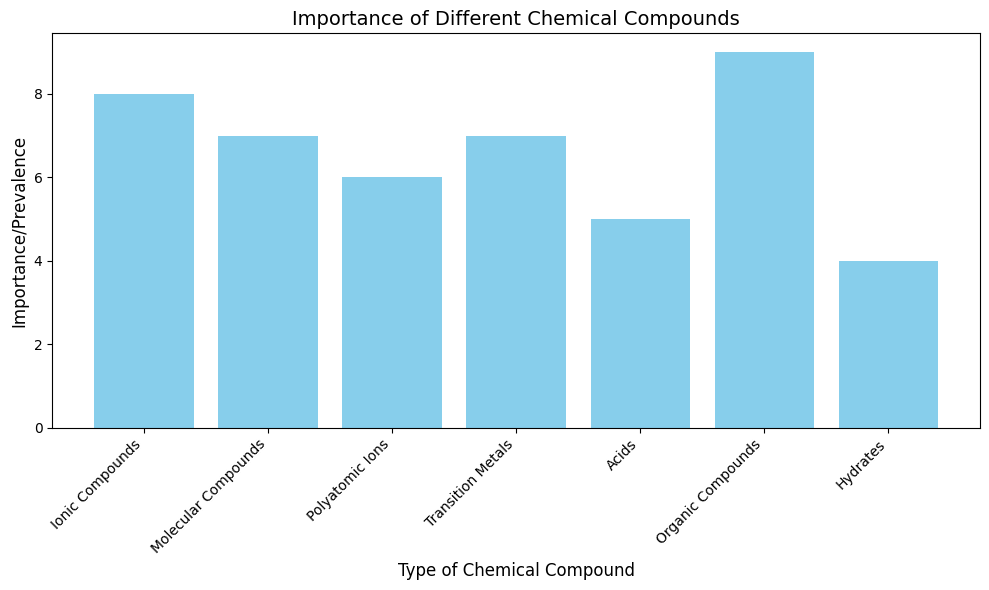
Acids are substances that release hydrogen ions (H+) when dissolved in water. The naming rules for acids depend on the type of acid. Binary acids, which consist of hydrogen and one other nonmetal element, are named by adding the prefix "hydro-" and the suffix "-ic" to the name of the nonmetal.
For example, hydrochloric acid (HCl) is a binary acid made from hydrogen and chlorine. On the other hand, oxyacids, which contain oxygen along with hydrogen and another element, follow a slightly different rule. If the anion ends in "-ate," the acid is named by changing the suffix to "-ic," as in sulfuric acid (H2SO4).
Organic chemistry deals with compounds primarily composed of carbon atoms. The naming of organic compounds follows a different set of conventions based on the structure and function of the molecule. Organic compounds are typically named according to the number of carbon atoms in the longest chain and the types of bonds between them.
For instance, methane (CH4) is the simplest organic compound, consisting of one carbon atom and four hydrogen atoms. As the number of carbon atoms increases, the naming conventions change. For example, ethane (C2H6) has two carbon atoms, and butane (C4H10) has four carbon atoms.
Hydrates are compounds that contain water molecules within their crystal structure. When naming hydrates, the name of the ionic compound is followed by a prefix indicating the number of water molecules present. These prefixes range from "mono-" for one water molecule to "decahydrate" for ten water molecules.
For example, copper(II) sulfate pentahydrate (CuSO4·5H2O) contains five water molecules. The prefix "penta-" indicates the number of water molecules in the hydrate.
While systematic names provide precise information about a compound’s structure, common names are often easier to remember and use in everyday contexts. For example, "water" is much more commonly used than "dihydrogen monoxide," despite the latter being the systematic name. Common names are often derived from history, culture, or the compound’s everyday use.
Trivial names, or common names, have been in use for centuries and often carry historical significance. These names, such as "ammonia" for NH3 or "alcohol" for ethanol, reflect the compound’s discovery or common usage in society. While these names are less precise than systematic names, they are still widely accepted in both casual and scientific discussions.
The Chemical Abstracts Service (CAS) assigns a unique number to every known chemical substance, known as a CAS number. This number provides a way to unambiguously identify a chemical compound, even if multiple compounds share similar names. CAS numbers are often used in research databases, regulations, and industry settings where precision is essential.
Name Type | Description | Example |
Systematic Name | Provides precise information about the compound's structure and composition. | Dihydrogen monoxide (H2O) |
Common Name | Easier to remember, often based on history, culture, or everyday usage. | Water |
Trivial Name | Historical names for chemicals, sometimes less precise but widely used. | Ammonia (NH3), Alcohol (C2H5OH) |
Despite the systematic approach to naming, ambiguities can still arise. For instance, some compounds share common names, which can lead to confusion. The same chemical might have different names based on the context, such as "alcohol" referring to either ethanol or isopropanol, depending on the industry or application.
In the chemical industry, naming conflicts can arise when multiple products have similar names. To avoid confusion, companies and regulators rely on more precise identifiers, such as CAS numbers or standardized IUPAC names, to ensure that products are accurately identified and regulated.
As the field of chemistry evolves, so too will the naming conventions. With the discovery of new compounds and the advancement of chemical research, new naming systems may emerge to address the growing complexity of modern chemistry. The continued role of IUPAC in refining these conventions will be essential in maintaining clarity and consistency in the scientific community.
Reason | Explanation |
Universal Language | Chemical nomenclature provides a consistent language for chemists worldwide, ensuring clear communication. |
Efficient Communication | By following standard naming rules, scientists can convey complex information about chemical compounds concisely. |
Industry Application | Chemical naming ensures that the right chemicals are identified and handled safely in manufacturing and regulatory contexts. |
Understanding chemical nomenclature is vital for those in chemistry or related fields. The systematic rules help scientists communicate accurately about compounds' structure, composition, and properties. Whether naming ionic compounds, organic molecules, or polyatomic ions, these conventions ensure clarity in scientific discussions. Companies like Jinan Xinggao Chemical Technology Co., Ltd. help navigate the complexities of chemistry with their quality products, offering valuable solutions for industries worldwide.
A: Chemical nomenclature refers to the system used to name chemical compounds. It ensures that chemicals are identified consistently across the scientific community.
A: It provides clarity and avoids confusion when communicating about chemical substances, ensuring scientists can accurately discuss their properties and structures.
A: Chemical compounds are named based on their composition. For example, ionic compounds are named with the cation first, followed by the anion, while molecular compounds use prefixes to denote the number of atoms.
A: Chemical compounds can be ionic, molecular, or polyatomic. Each type follows its own naming rules, ensuring proper identification and understanding of their structure.
A: The International Union of Pure and Applied Chemistry (IUPAC) defines the rules for chemical naming, providing a standardized approach for clarity and consistency.
A: Chemical naming is crucial for industries, ensuring that chemicals are correctly identified, leading to safer handling and precise formulations in products.


